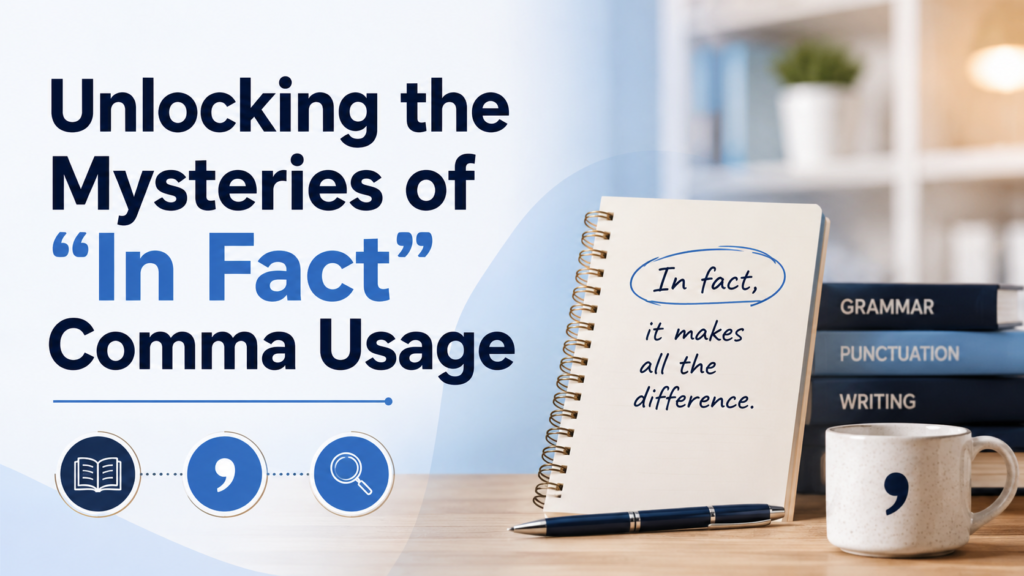

In my daily venturing into the realm of writers, Unlocking the Mysteries of “In Fact” Comma Usage shows how we bend rules wisely.As a writer, I once though I didn’t need a degree in English to be an expert, but a few grammar hacks I learned truly helped. These five hacks improved how I approach writing and everything that comes with it. Style guides are slightly different, and this is especially true for punctuation rules; the outcome we often cover includes MLA, but we should also make a note of other styles that differ significantly from the beginning of any module. I remember long ago in Bisbee
Arizona, finishing, wiping breakfast dishes, getting ready for a walk to school, hearing a morning radio talk show where Arlo and Ray were signing off before a commercial about Dreft, a powdered dish soap my mother trusted. That choice caught my attention when a mother-in-law spoke of a burn risk that could appear while attempting to guide a daughter-in-law on the right way to pour soap into one hand or the other hand, where one suffered the most from ensuing chemical burns.
Recently, my son and his daughter-in-law Kathleen came to visit past weekend; I love her to pieces. She raised four boys, not a shrinking violet, and now works as a manager in community outreach for a network of credit unions across eastern Washington, Idaho, and Montana. She and her co-workers are currently working mostly from home, telling me about a series of chats that devolved into something considered unseemly, almost gone viral, but she mentioned it wasn’t a problem, just a conversation between us.
What “In Fact” Means in Sentence Structure and Comma Usage
Before talking commas, we need to understand the phrase itself.
“In fact” is a transition expression used to:
- Emphasize a statement
- Correct or strengthen previous information
- Add surprising or clarifying detail
Think of it as a verbal spotlight. It tells the reader:
“Pay attention—this point adds weight or clarity.”
Simple examples of meaning
- I thought he was late. In fact, he arrived early.
- She looks tired. In fact, she hasn’t slept in two days.
Notice something important: the phrase doesn’t change meaning alone—it changes tone and emphasis.
The Core Rule of “In Fact” Comma Usage
Let’s make this simple.
There are only two real situations you need to remember:
- At the beginning of a sentence → usually use a comma
- In the middle of a sentence → usually no comma
That’s it.
Now let’s break it down properly so it sticks.
When You SHOULD Use a Comma After “In Fact”
At the Beginning of a Sentence (Standard Rule)
When “in fact” starts a sentence, you almost always need a comma after it.
Why?
Because it creates a natural pause in spoken English. That pause improves clarity and rhythm.
Correct examples
- In fact, I already finished the report.
- In fact, she was the one who called first.
- In fact, the results were better than expected.
Without the comma, the sentence feels rushed and slightly awkward.
Think of it like this
“In fact” at the start is like stepping onto a stage and saying:
“Hold on—let me add something important.”
The comma is your breath before delivering the point.
When “In Fact” Adds Emphasis or Contrast
Sometimes “in fact” doesn’t just continue an idea—it corrects it or strengthens it strongly.
In these cases, the comma is still required at the start.
Example contrast
- I thought the test was hard. In fact, it was easy.
- He seemed angry. In fact, he was just tired.
The comma helps the reader absorb the shift in meaning.
Without it, the sentence feels cramped and less natural.
When You DON’T Need a Comma After “In Fact”
Now let’s flip the rule.
Not every “in fact” needs punctuation around it.
When It Appears in the Middle of a Sentence
If “in fact” sits naturally inside a sentence, you usually skip commas.
Correct examples
- That is in fact true.
- The story is in fact based on real events.
- She is in fact the best candidate for the job.
Here, commas would interrupt flow.
Why this works
Because “in fact” is acting like a soft emphasis—not a full pause or transition.
When Commas Make Writing Sound Artificial
Many learners over-punctuate like this:
❌ That is, in fact, true.
This is grammatically acceptable but often feels overly formal or stiff in modern writing.
Compare:
- ✔ That is in fact true. (smooth, natural)
- ⚠️ That is, in fact, true. (heavy, dramatic pause)
In everyday writing, simplicity wins.
Common Mistakes in “In Fact” Comma Usage
Even experienced writers slip up. Here are the most frequent errors.
Overusing commas everywhere
Some writers think commas always improve clarity. They don’t.
❌ In fact, she, in fact, agreed with him.
That looks cluttered and slows reading.
Forgetting the opening comma
This is even more common:
❌ In fact I was right.
✔ In fact, I was right.
Missing the comma removes the natural pause.
Using “in fact” as filler
Some people drop “in fact” too often in writing.
Example:
- In fact, I think in fact we should in fact go now.
This weakens writing instead of strengthening it.
Confusing it with “actually”
While similar, they are not identical.
| Phrase | Function |
| In fact | Emphasizes truth or correction |
| Actually | Often softens or contradicts politely |
Quick Comparison Table: Correct vs Incorrect Usage
| Sentence | Correct? | Explanation |
| In fact I was there | ❌ | Missing comma after opening phrase |
| In fact, I was there | ✅ | Correct natural pause |
| That is, in fact, true | ⚠️ | Grammatically correct but heavy |
| That is in fact true | ✅ | Smooth embedded usage |
| She, in fact, agreed | ❌ | Unnecessary interruption |
| She in fact agreed | ✅ | Natural flow |
How Native Writers Use “In Fact” in Real Writing
Native speakers don’t follow rigid grammar rules in real time. They follow rhythm.
That rhythm depends on:
- Breathing pauses
- Emphasis level
- Sentence flow
Journalism style
News writing often uses:
- In fact, the company reported record profits.
Why? Because journalists want clarity and impact.
Casual writing style
Blogs and everyday writing prefer:
- That is in fact the problem.
It sounds smoother and less formal.
Academic writing style
Academics sometimes prefer the more structured version:
- The results, in fact, support the hypothesis.
Here, commas help signal careful analysis.
Read More: Mastering the Simple Present Tense in American English
Case Study: How “In Fact” Changes Tone in Writing
Let’s look at a practical transformation.
Scenario: Email communication
❌ In fact I think your proposal is good but needs revision.
This feels rushed and slightly unprofessional.
✔ In fact, I think your proposal is good but needs revision.
Now it sounds clearer and more respectful.
Scenario: Storytelling
❌ He was not nervous in fact he was excited.
✔ He was not nervous. In fact, he was excited.
The second version builds suspense and rhythm.
Scenario: Argument writing
❌ The plan is in fact flawed.
✔ The plan is, in fact, flawed. (formal tone)
✔ The plan is in fact flawed. (neutral tone)
Both are correct. The choice depends on tone.
Simple Memory Trick for “In Fact” Comma Usage
Here’s a rule you can actually remember:
Start of sentence = comma after “in fact”
Middle of sentence = usually no comma
That’s the core.
If you want a shortcut:
- Pause in speech → use comma
- No pause → skip comma
Simple. Practical. Reliable.
Practical Examples You Can Copy and Use
Let’s solidify everything with real examples.
At the start of sentences
- In fact, I was already aware of the issue.
- In fact, the solution was surprisingly simple.
- In fact, they never agreed to the terms.
In the middle of sentences
- The results are in fact quite promising.
- She is in fact the manager of the team.
- That claim is in fact misleading.
With contrast
- I expected failure. In fact, I succeeded.
- He seemed unprepared. In fact, he was overqualified.
Why “In Fact” Comma Usage Matters More Than You Think
This isn’t just grammar trivia.
Correct punctuation:
- Improves clarity
- Controls tone
- Builds trust with readers
- Makes writing feel natural
Bad punctuation does the opposite. It creates hesitation and confusion.
Think of commas like traffic signals. They don’t just decorate sentences—they guide readers safely through meaning.
Conclusion
Understanding how to use in fact with the right comma is not about strict rules alone—it’s about clarity and flow. When used well, it helps you communicate your exact message, guide your readers, and make your writing feel natural. I’ve seen many writers struggle at first, but once you learn how punctuation works, it becomes an extensive toolset you can rely on.
Whether you follow MLA or other style guides, the key is to stay consistent and craft your language in a way that connects ideas smoothly.
FAQs
What does “in fact” mean in a sentence?
“In fact” is used to add emphasis or introduce a stronger point. It helps show that something is true or even more important than expected.
Do you always need a comma before “in fact”?
Not always. Use a comma when “in fact” interrupts a sentence or adds extra detail. If it flows naturally without a pause, a comma may not be needed.
Can “in fact” start a sentence?
Yes, it can. When it starts a sentence, it is usually followed by a comma to separate it from the main idea.
Is comma usage the same in all style guides?
No, style guides like MLA or others may have slightly different rules, but the basic idea of clarity stays the same.
How can I improve my punctuation skills?
Practice regularly, read more articles, and focus on how words relate to each other. Over time, you will learn to use punctuation naturally.