
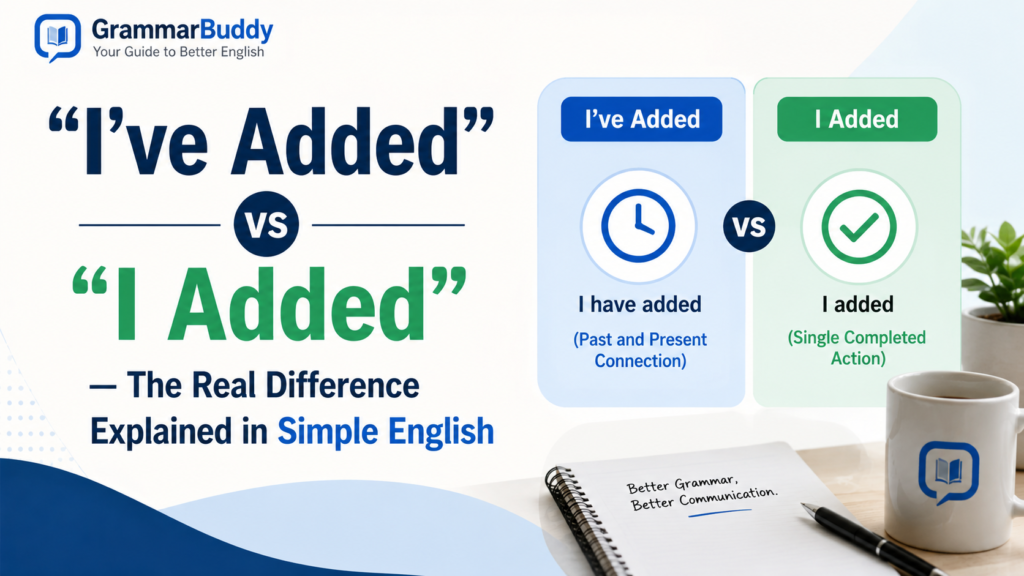

I’ve Added” vs “I Added” helps English learners fix confusion by showing how tense, context, and timing change meaning in use now .From my experience in writing and speaking English, I’ve seen that choosing the right verb form often changes clarity, tone, and message in a sentence. The phrases “I’ve added” and “I added” look almost identical, yet they serve different purposes depending on tense, context, and timeline.
Many learners get confused because both relate to completed actions, but the real nuance lies in when the action happened and how it connects to the present moment. I’ve also noticed years of this pattern, where learners rely on guessing, creating confusion in everyday communication like emails, chats, reports, and conversations.
In real usage, I’ve added (present perfect tense) is used for recent or ongoing relevance, while I added (simple past tense) refers to a specific completed action in the past. For example, “I’ve added the file” in a workplace chat means it is still relevant now, but “I added the results on Monday” shows a specific time reference. This guide breaks differences and helps learners build a natural understanding of grammar choices, improving accuracy, fluency, and confidence in American English usage.
Quick Meaning of “I’ve Added” vs “I Added”
Before diving deep, here’s the simple version:
- “I’ve added” (Present Perfect) → Focus on the result now
- “I added” (Simple Past) → Focus on the action in the past
Think of it like this:
- One tells you what is true now
- The other tells you what happened before
That small shift changes everything.
The Grammar Behind “I’ve Added” vs “I Added”
These two phrases come from different tenses:
Present Perfect: “I’ve added”
\text{Present Perfect: have/has + past participle}
This tense connects the past action to the present moment.
Simple Past: “I added”
\text{Simple Past: verb + ed (or past form)}}
This tense talks about a finished action in the past.
What “I’ve Added” Really Means in Real Life
When you say “I’ve added,” you are not just talking about the past.
You are saying:
“I did something, and it still matters right now.”
Real examples
- “I’ve added your name to the list.” → Your name is there now
- “I’ve added new photos to the folder.” → They are available right now
- “I’ve added the update.” → The system is updated at this moment
Key idea
You use it when the result is important right now, not the exact time it happened.
A helpful way to remember it:
Present Perfect = Past action with present impact
What “I Added” Really Means in Real Life
Now switch to “I added.”
This one is more straightforward. No hidden connection to the present.
You are simply reporting:
“This happened in the past. It’s done.”
Real examples
- “I added your name yesterday.”
- “I added sugar to the tea this morning.”
- “I added the file last night.”
Key idea
You use it when the time matters more than the result.
Think of it like telling a story, not updating a situation.
The Real Difference People Actually Feel (Not Just Grammar Rules)
Grammar books explain rules. But real usage feels different.
Here’s what native speakers instinctively do:
- They use “I’ve added” when they want to sound current and relevant
- They use “I added” when they want to sound like they are reporting something completed
Example comparison
- “I’ve added the file.” → It’s there now, ready to use
- “I added the file yesterday.” → Just sharing when it happened
One feels alive in the present.
The other feels like a past report.
That’s the emotional difference most learners miss.
Side-by-Side Comparison Table
| Feature | I’ve Added (Present Perfect) | I Added (Simple Past) |
| Focus | Result now | Completed action |
| Time mentioned | Usually not stated | Often stated |
| Connection to present | Strong | Weak or none |
| Tone | Relevant, active | Historical, factual |
| Example | I’ve added your file | I added your file yesterday |
When Both Are Correct (But Feel Different)
Sometimes, both options work. But the meaning shifts slightly.
Example situation
You upload a document.
- “I’ve added the document.” → It’s ready now, you can use it
- “I added the document.” → I’m just informing you what I did
Same action. Different focus.
This is why English feels flexible but tricky at the same time.
Common Mistakes Learners Make
Let’s fix the most common errors so you avoid sounding unnatural.
❌ Wrong usage examples
- “I’ve added it yesterday.” (Incorrect mix of tense and time)
- “I added it just now” (Not natural in many contexts)
✅ Correct versions
- “I added it yesterday.”
- “I’ve just added it.”
Why this matters
Present perfect does not like specific past time words like:
- yesterday
- last week
- in 2020
Simple past loves those.
Simple Memory Trick That Actually Works
Here’s an easy mental shortcut:
- If you think about NOW → say “I’ve added”
- If you think about WHEN → say “I added”
Or even shorter:
Now = I’ve added
Then = I added
This trick works in emails, chats, and conversations without overthinking grammar rules.
Real-Life Conversation Example
Let’s see how this plays out in real situations.
Work email
- “I’ve added the report to the folder. You can check it now.”
Chat message
- “I added it already, check your inbox.”
Instruction context
- “I’ve added the steps you requested.”
Storytelling
- “I added extra sugar, but it still didn’t taste right.”
Notice how tone changes depending on intent.
Case Study: Why This Difference Matters in Professional English
Imagine you’re working in a tech company.
You write:
- “I added the update.”
- “I’ve added the update.”
What happens?
- The first sounds like you finished something earlier
- The second tells your team it’s ready to use now
In fast-moving environments like tech, logistics, or customer support, this difference can avoid confusion.
A small change in tense can change urgency.
Expert Insight (Why Native Speakers Don’t Think About It)
Native speakers don’t consciously apply rules.
They rely on instinct:
- If they care about impact → present perfect
- If they care about timeline → simple past
That’s why both forms feel natural to them.
As one linguistics explanation puts it:
Conclusion
In simple terms, “I’ve added” and “I added” are not the same even though they look similar. The difference is all about time, context, and connection to the present moment. When you use present perfect tense (I’ve added), you show that the action is recent or still relevant now. But when you use simple past tense (I added), you are talking about a completed action at a specific time in the past.
Once learners understand this small but important difference, their writing, speaking, and daily communication become much clearer and more natural. Instead of guessing, you start choosing the correct form based on meaning, which improves grammar accuracy, fluency, and confidence in English.
FAQs
1. What is the main difference between “I’ve added” and “I added”?
“I’ve added” shows a recent or relevant action, while “I added” shows a finished action at a specific time in the past.
2. When should I use “I’ve added”?
Use “I’ve added” when the action is recent, important now, or has no specific time mentioned.
3. When should I use “I added”?
Use “I added” when you mention a clear past time like yesterday, last week, or Monday.
4. Why do learners confuse these two forms?
Because both refer to the past, but they differ in time connection and present relevance.
5. Can both be used in daily English?
Yes, both are common in emails, chats, conversations, and reports, depending on the situation and timing.