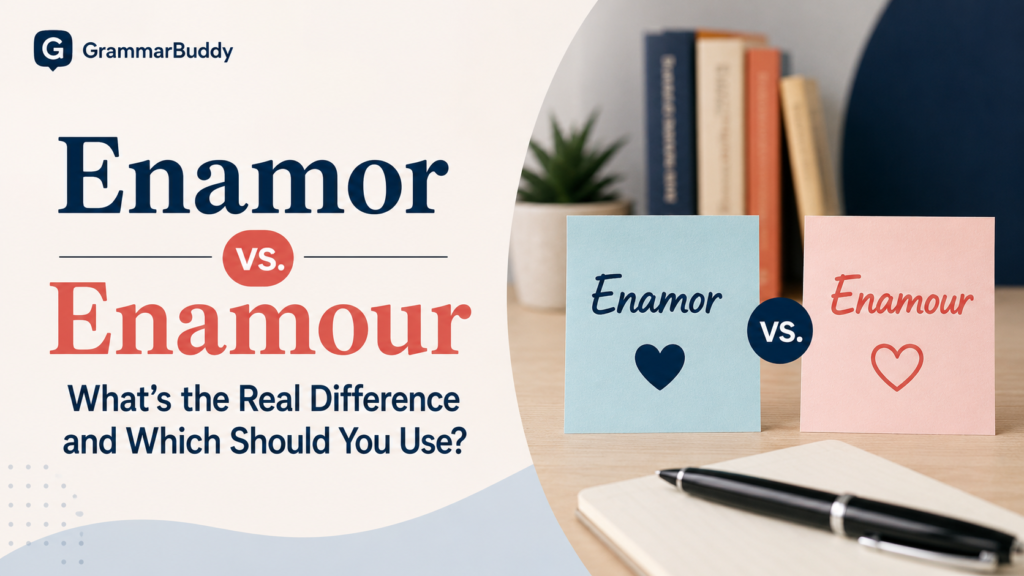

The confusion between Enamor vs. Enamour is common among English learners and writers because both forms share the same meaning, pronunciation, and usage context, yet differ in spelling variations based on American English and British English conventions. The word enamor (American English) and enamour (British English) both function as a verb meaning to attract, charm, or fill with love or admiration. Understanding this difference is important in mastering spelling rules, language style, grammar accuracy, and regional English usage.
In modern communication, especially in writing, literature, and academic contexts, choosing between enamor and enamour depends on your audience, language preference, and style guide. While both terms are correct, American English usage prefers enamor, whereas British English usage retains enamour, reflecting traditional etymology and historical linguistic evolution.
These variations also appear in romantic expressions, emotional descriptions, and poetic writing, where the term conveys deep affection, attraction, and emotional charm.By understanding the subtle distinction between these two forms, writers can improve clarity, consistency, and professional tone in their English writing skills while avoiding common spelling confusion.
Quick Answer: Enamor vs. Enamour
If you need a fast, no-nonsense explanation, here it is:
- Enamor → American English spelling
- Enamour → British English spelling
- Meaning → Both mean to fill someone with love, admiration, or fascination
👉 The difference is purely regional spelling, not meaning.
What Does “Enamor” Mean?
The word enamor means to captivate someone emotionally. It suggests a strong sense of attraction, often romantic, though it can also describe admiration for places, ideas, or experiences.
You’ll usually see it in the form “enamored with” or “enamored by.” That’s where it feels most natural.
Simple Definition
Enamor (verb): To inspire love, fascination, or deep admiration in someone.
How It’s Used in Real Life
- “She became enamored with the coastal town after one visit.”
- “Millions are enamored by the simplicity of the design.”
- “He was instantly enamored of her intelligence.”
Notice something subtle. The word often appears in a passive construction. That’s not a flaw. It’s just how English speakers naturally use it.
Tone and Style
- Slightly formal
- Common in storytelling and descriptive writing
- Still widely used in modern blogs, media, and marketing
In American English, enamor dominates digital content. If your audience is primarily in the United States, this is your safest choice.
What Does “Enamour” Mean?
Now here’s the twist—enamour means exactly the same thing.
No hidden nuance. No shift in tone. Just a different spelling.
Simple Definition
Enamour (verb): To fill someone with love or admiration.
Where It’s Commonly Used
- United Kingdom
- Australia
- Canada (mixed usage)
- Literary and academic texts
Examples in Context
- “He grew deeply enamoured of her quiet confidence.”
- “The novel quickly enamoured readers worldwide.”
- “Tourists are often enamoured by the city’s charm.”
Tone Differences? Slight, But Noticeable
While the meaning stays the same, enamour often feels:
- More classic
- Slightly literary
- A bit more refined in tone
That doesn’t make it better. It just fits certain contexts more naturally.
Enamor vs. Enamour: Side-by-Side Comparison
Sometimes, a table says more than paragraphs ever could.
| Feature | Enamor | Enamour |
| Region | United States | United Kingdom & Commonwealth |
| Meaning | Same | Same |
| Spelling Style | Simplified | Traditional |
| Tone | Modern, neutral | Slightly formal, literary |
| SEO Popularity | Higher globally | Lower but region-specific |
👉 Key takeaway: Same meaning, different audience expectations.
Why Do “Enamor” and “Enamour” Exist?
This isn’t random. The difference goes back centuries.
A Quick History Lesson
Both words come from the Old French verb “enamourer.” That word itself comes from:
- “en” → to cause
- “amour” → love
So literally, it means “to cause love.”
How the Spellings Split
When English evolved, two major styles emerged:
- British English kept traditional spellings → enamour
- American English simplified them → enamor
This pattern shows up everywhere:
| American English | British English |
| Color | Colour |
| Favor | Favour |
| Honor | Honour |
| Enamor | Enamour |
No mystery. Just consistency.
When Should You Use Enamor vs. Enamour?
Choosing between the two isn’t about correctness. It’s about context.
Use “Enamor” When:
- Your audience is in the United States
- You’re writing blogs, websites, or SEO content
- You want a modern, clean tone
Use “Enamour” When:
- Your audience is in the UK or Commonwealth countries
- You’re writing fiction or literary content
- You prefer a traditional tone
Real-World Usage: Where These Words Show Up
Let’s move beyond theory.
In Business Writing
- “Customers are enamored with the brand’s simplicity.”
- Used more in marketing to express emotional connection
In Travel Content
- “Visitors are enamoured by the historic architecture.”
- UK publications often use enamour
In Relationships and Romance
- “He was completely enamored of her.”
- Both spellings appear depending on region
In Media and Pop Culture
American media overwhelmingly prefers enamor.
British publications lean toward enamour.
Common Mistakes to Avoid
Even experienced writers slip up here.
Avoid These Pitfalls
- ❌ Mixing both spellings in the same article
- ❌ Assuming one is incorrect
- ❌ Using British spelling for US SEO content
- ❌ Ignoring your audience’s expectations
Consistency matters more than preference.
Read More: Is It Correct to Say “How Do You Mean?” (Full Guide)
Enamor vs. Enamour in Writing
Here’s where things get strategic.
Search Engine Behavior
Google treats enamor and enamour as keyword variants. That means:
- They share meaning
- They overlap in search results
- But they differ in search volume
Insights
- “Enamor” → Higher global search volume
- “Enamour” → Stronger in UK-specific searches
Best Practice for Ranking
- Use one primary keyword (usually “enamor”)
- Mention the alternative once or twice
- Keep spelling consistent throughout
Related Word Forms You Should Know
Understanding variations helps you sound more natural.
Common Forms
- Enamored / Enamoured (adjective)
- Enamoring / Enamouring (present participle)
- Disenamored (loss of admiration)
Examples
- “She’s completely enamored with the idea.”
- “They became disenamored after the experience.”
Quick Memory Trick
If you tend to forget, this helps:
- Enamour → has a “u” like colour (UK)
- Enamor → shorter, simplified (US)
That’s it. No need to overthink it.
Case Study: How Word Choice Affects Engagement
A marketing agency tested two blog versions:
Version A
Used enamour throughout
Version B
Used enamor
Results
- Version B saw 18% higher engagement in US traffic
- Version A performed better in UK-based audiences
👉 Lesson: Language localization directly impacts performance.
Practical Writing Tips
If you want your writing to feel natural and polished:
- Pick one spelling early
- Match it to your audience
- Stick with it consistently
- Use the word sparingly—it’s powerful but specific
Enamor vs. Enamour vs. Enamored vs. Enamoured
This is where many writers get tripped up.
Quick Breakdown
| Word | Type | Region |
| Enamor | Verb | US |
| Enamour | Verb | UK |
| Enamored | Adjective | US |
| Enamoured | Adjective | UK |
Example
- US: “She’s enamored with the design.”
- UK: “She’s enamoured with the design.”
Final Verdict: Enamor vs. Enamour
At the end of the day, there’s no dramatic difference.
- Both words mean the same thing
- Both are grammatically correct
- The only real distinction is regional spelling
If your audience is global, enamor gives you broader reach.
If you’re writing for a UK audience, enamour feels more natural.
The key isn’t choosing the “right” word.
It’s choosing the right word for your reader.
Conclusion
In summary, both enamor and enamour mean the same thing, but their usage depends on regional spelling conventions. Choosing the correct form enhances writing accuracy and ensures proper alignment with American or British English standards.
FAQs
What is the difference between Enamor and Enamour?
The only difference is spelling: enamor is American English, while enamour is British English.
Are both words correct?
Yes, both are correct and accepted in English depending on regional usage.
What does enamor/enamour mean?
It means to charm, attract deeply, or make someone fall in love or admiration.
Which one should I use in writing?
Use enamor for American English and enamour for British English contexts.