
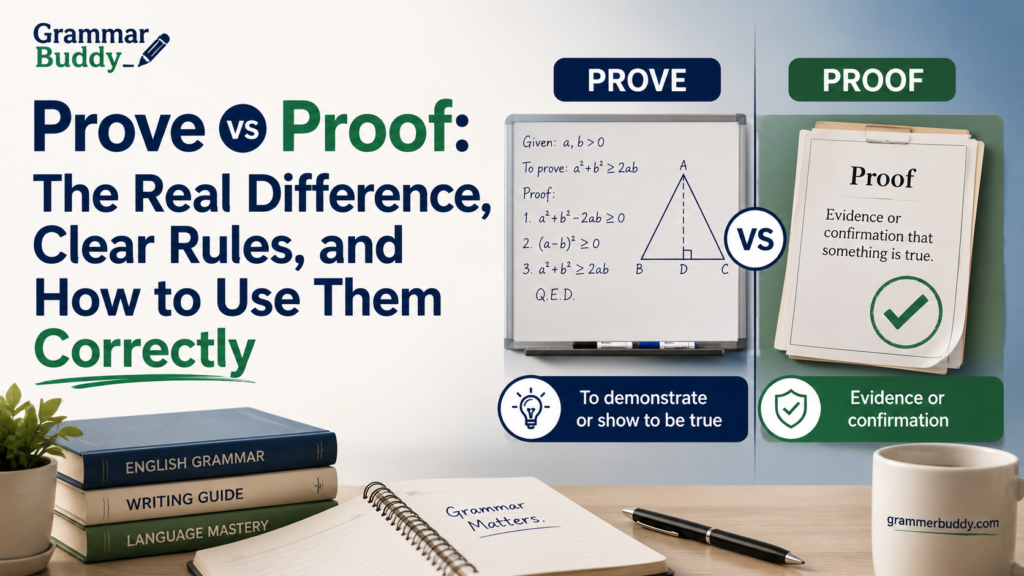

Understanding the difference between Prove vs Proof is essential for clear communication in both everyday language and formal writing. Although these terms are closely related, they serve different grammatical roles and are used in distinct contexts. Prove is a verb, meaning to demonstrate, establish, or verify the truth of something through evidence, logic, or argument. On the other hand, proof is a noun that refers to the evidence, confirmation, or validation itself.
This distinction often confuses learners, especially when dealing with grammar rules, usage differences, and sentence structure.In academic writing, legal contexts, and even casual conversations, knowing when to use prove versus proof can improve clarity, precision, and credibility. For example, you prove a claim, but you present proof of a claim.
These terms also appear in various fields such as mathematics, law, science, and philosophy, where accurate usage is critical. Mastering the difference between prove vs proof helps avoid common language mistakes, enhances writing skills, and strengthens communication effectiveness. By learning their meanings, functions, and examples, you can confidently use both words in the right context.
Quick Answer: Prove vs Proof (No Confusion)
Let’s clear it up immediately:
- Prove = an action (verb)
- Proof = a thing (noun)
Simple Examples:
- You prove something.
- You show proof of something.
👉 Key rule:
“Prove” is what you do. “Proof” is what you have.
Why “Prove” and “Proof” Confuse So Many People
At first glance, they feel interchangeable. That’s where the trouble starts.
Here’s why confusion happens:
- Both relate to truth and evidence
- They share the same origin
- They often appear in the same sentence
- They sound almost identical
Real Example of Confusion:
❌ “Show me the prove.”
❌ “I will proof it.”
These mistakes happen because people mix function (verb vs noun).
What Does “Prove” Mean? (Full Breakdown)
Definition of Prove
Prove means to show that something is true using facts, logic, or evidence.
👉 In simple words:
You prove something by demonstrating it.
How “Prove” Works in Sentences
- It is always a verb
- It shows action
- It often needs an object
Examples:
- She will prove her innocence.
- Scientists prove theories through experiments.
- He tried to prove his point.
Forms of “Prove**
| Form | Example |
| Base | prove |
| Present | proves |
| Past | proved |
| Participle | proven / proved |
Proven vs Proved
- Proved = simple past
- Proven = past participle
Examples:
- He proved his skills yesterday.
- He has proven his skills over time.
What Does “Proof” Mean? (Full Breakdown)
Definition of Proof
Proof refers to evidence or information that shows something is true.
👉 In simple words:
Proof is the result of proving.
How “Proof” Works in Sentences**
- It is a noun
- It represents evidence or confirmation
Examples:
- Do you have proof of identity?
- This document is solid proof.
- There’s no proof of that claim.
Different Meanings of “Proof”**
- Evidence (most common)
- Mathematics (logical reasoning)
- Printing (draft copy)
- Baking (fermentation stage)
Prove vs Proof: Side-by-Side Comparison
| Feature | Prove | Proof |
| Part of Speech | Verb | Noun |
| Meaning | To demonstrate truth | Evidence of truth |
| Role | Action | Object |
| Example | I will prove it | I have proof |
Prove vs Proof in Sentences (Clear Contrast)
Incorrect vs Correct:
| Incorrect Sentence | Correct Sentence |
| I will proof it | I will prove it |
| Show me the prove | Show me the proof |
| He gave me no prove | He gave me no proof |
Real-Life Use Cases (Where It Actually Matters)
Academic Writing
- Researchers prove theories
- Papers provide proof
Legal Context
- Lawyers must prove claims
- Courts require proof
Everyday Conversation
- “I can prove it!”
- “Where’s your proof?”
Case Study: How One Word Changes Meaning
Scenario:
❌ “This experiment gives prove that the theory is correct.”
Correct Version:
✅ “This experiment gives proof that the theory is correct.”
Why It Matters:
- “Prove” = action
- “Proof” = result
Read More: Dialog vs Dialogue: What’s the Difference, Usage Rules, and Real-World Examples
Common Mistakes (And How to Avoid Them)
- Using proof as a verb ❌
- Using prove as a noun ❌
- Confusing proven vs proved
Quick Fix Tip:
- Replace with “show” → prove
- Replace with “evidence” → proof
Memory Tricks You’ll Actually Remember
- Prove = Verb = Action
- Proof = Object = Thing
👉 You prove a case using proof.
Proof vs Evidence (Extra Clarity)
| Term | Meaning |
| Evidence | Suggests something is true |
| Proof | Confirms something is true |
Practice Section
Fill in the blanks:
- Can you ______ it?
- Show me the ______.
- He has ______ his point.
- There is no ______ of that claim.
Answers:
- prove
- proof
- proven / proved
- proof
Conclusion
In summary, the distinction between Prove vs Proof lies in their grammatical roles and usage. Prove is an action you perform to establish truth, while proof is the result or evidence that supports that truth. Recognizing this difference helps you write and speak more accurately,
whether in academic, professional, or casual settings. Mastering these terms not only improves grammar but also enhances overall communication clarity.
FAQs
What is the main difference between prove and proof?
Prove is a verb used to show something is true, while proof is a noun referring to the evidence that supports it.
Can prove and proof be used interchangeably?
No, they cannot be used interchangeably because they serve different grammatical functions.
How do you use prove in a sentence?
You can say, “She will prove her point with strong arguments.”
How do you use proof in a sentence?
You can say, “He provided proof of his innocence.”
Why is understanding prove vs proof important?
It helps improve grammar accuracy, writing clarity, and effective communication.