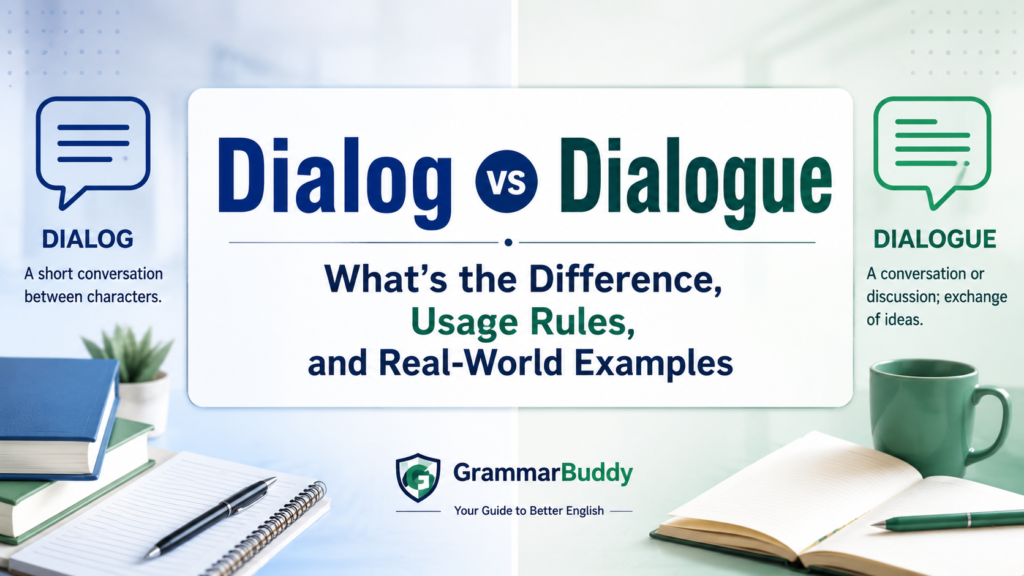

Understanding the difference between Dialog vs Dialogue is essential for clear and effective communication, especially in writing and literature. Although these two terms are often used interchangeably, they carry slightly different meanings depending on context. Dialog, commonly used in American English, refers to a conversation between two or more people, often seen in scripts, plays, or informal writing. On the other hand, Dialogue is the preferred spelling in British English and is widely used in academic, literary, and formal contexts.
When exploring Dialog vs Dialogue, it’s helpful to recognize how both forms relate to conversation, communication, speech, discussion, verbal exchange, narrative writing, fiction, scriptwriting, character interaction, and literary style. Writers often focus on realistic dialogue, engaging conversation, character voice, tone, expression, and language clarity to make their content more compelling.
Whether you are crafting a novel, screenplay, or blog, understanding the subtle distinction between dialog spelling, dialogue usage, grammar rules, writing techniques, and English variations can improve your writing quality. Ultimately, both terms serve the same purpose: representing spoken words, but their usage depends on regional preferences and stylistic choices.
Quick Answer: Dialog vs Dialogue
If you need a fast, no-nonsense answer, here it is:
- Dialogue is the standard spelling in general writing, literature, and formal contexts
- Dialog is commonly used in technical fields, especially computing and UI design
- Both are correct, but context determines which one you should use
Why the Confusion Between Dialog and Dialogue Exists
English loves borrowing words. The word “dialogue” comes from the French dialogue, which traces back to Greek roots meaning “conversation between two people.”
Over time, American English began simplifying certain spellings. You’ve probably seen similar patterns:
- Colour → Color
- Catalogue → Catalog
- Programme → Program
The same shortening trend led to “dialog” emerging as a variant of “dialogue.”
However, there’s a twist.
While many shortened forms became widely accepted everywhere, “dialog” found a niche in technology rather than general writing.
Real-World Influence of Technology
Software development played a huge role here. Early computer interfaces needed concise labels. As a result:
- “Dialog box” became standard in operating systems
- Programmers adopted “dialog” in documentation
- UI/UX writers favored shorter, cleaner terminology
So now, we have a split:
- Writers and editors prefer “dialogue”
- Developers and tech professionals prefer “dialog”
Definitions and Core Meaning of Dialog vs Dialogue
What Does “Dialogue” Mean?
Dialogue refers to a conversation between two or more people. It’s widely used in:
- Novels and short stories
- Screenplays and scripts
- Academic writing
- Journalism
Example:
The dialogue between the characters revealed hidden tension.
In writing, dialogue does more than show speech. It builds character, drives the plot, and adds realism.
What Does “Dialog” Mean?
Dialog is a shortened version of “dialogue.” While it can technically mean the same thing, it’s mostly used in technical contexts.
You’ll see it in:
- Software interfaces
- Programming documentation
- UX/UI design
Example:
Click “OK” to close the dialog.
Here, “dialog” refers to a user interface element, not a conversation.
Key Differences Between Dialog and Dialogue
Here’s a clear comparison to remove any doubt:
| Feature | Dialogue | Dialog |
| Meaning | Conversation | UI element or technical term |
| Usage | General writing | Technical/computing contexts |
| Region | US and UK English | Mostly US (tech industry) |
| Formality | Formal and standard | Informal outside tech |
| Common Context | Books, films, essays | Software, apps, coding |
When to Use “Dialogue” (With Practical Examples)
Use dialogue whenever you’re writing for a general audience.
Best Contexts for “Dialogue”
- Fiction and storytelling
- Screenwriting
- Academic papers
- Blog posts and articles
- Journalism
Examples in Real Writing
- The dialogue in the novel felt authentic and engaging
- Strong dialogue can reveal a character’s personality
- Teachers often analyze dialogue to understand themes
Pro Tip
If your content involves human conversation, stick with dialogue. It’s the safest and most widely accepted choice.
When to Use “Dialog” (With Practical Examples)
Use dialog in technical environments where the term refers to a system interface.
Best Contexts for “Dialog”
- Software development
- User interface (UI) design
- Technical documentation
- Programming tutorials
Examples in Real Usage
- Open the settings dialog to adjust preferences
- The error dialog displays a warning message
- This dialog box requires user input
Important Insight
In tech, using “dialogue” instead of “dialog” can look outdated or incorrect. Industry norms matter here.
Dialog Box vs Dialogue Box: Which One Is Correct?
This is where many writers hesitate.
The Reality
- “Dialog box” is the standard term in computing
- “Dialogue box” is grammatically valid but rarely used in tech
Why “Dialog Box” Wins
- Shorter and cleaner
- Widely adopted by companies like Microsoft
- Matches programming language conventions
Quick Comparison
| Term | Correctness | Usage Frequency |
| Dialog box | Industry standard | Very common |
| Dialogue box | Technically valid | Rare |
American vs British English Usage
Spelling differences often come down to geography.
American English
- Uses both dialog and dialogue
- “Dialog” appears more in tech contexts
British English
- Strongly prefers dialogue
- Rarely uses “dialog,” even in technical writing
Key Takeaway
If your audience is global, “dialogue” is the safer choice unless you’re writing specifically for a tech audience.
Read More: Deadbeat – Definition, Meaning, and Real-Life Usage Explained Clearly (Complete Guide)
Style Guides and Industry Standards
Professional writing follows established style guides. These influence which spelling is preferred.
Major Style Guide Preferences
- Chicago Manual of Style → Dialogue
- AP Stylebook → Dialogue
- Oxford Style Guide → Dialogue
- Microsoft Writing Style Guide → Dialog
What This Means for You
- Writing an article or essay? Use dialogue
- Writing software documentation? Use dialog
Common Mistakes to Avoid
Even experienced writers slip up here.
Mistakes That Hurt Credibility
- Using dialog in formal essays
- Mixing “dialog” and “dialogue” in one piece
- Assuming “dialog” is always incorrect
Better Approach
Pick one form based on context and stick with it.
Writing Tip: Consistency Matters
If you’re creating content for search engines, consistency isn’t optional—it’s essential.
Best Practices
- Choose your primary keyword: dialog vs dialogue
- Use variations naturally:
- dialog or dialogue
- difference between dialog and dialogue
- dialog vs dialogue usage
- Avoid switching randomly between spellings
Example Strategy
If your article targets writers, use dialogue more often.
If it targets developers, lean toward dialog.
Real-World Examples Across Different Contexts
Let’s look at how each term appears in real life.
Literature
“The novel’s dialogue captures the emotional depth of the characters.”
Film and Screenwriting
“Sharp dialogue keeps the audience engaged.”
Software Interface
“The dialog prompts the user to confirm the action.”
UX Writing
“Keep dialog messages clear and concise.”
Case Study: How Context Changes Everything
Scenario 1: Blog Writer
A content writer publishes an article about storytelling.
- Correct choice: Dialogue
- Why: Audience expects standard English
Scenario 2: Software Developer
A developer writes documentation for an app.
- Correct choice: Dialog
- Why: Matches industry terminology
Result
Using the wrong term in each scenario reduces clarity and professionalism.
Expert Insight
“Language evolves based on usage, not rules alone. ‘Dialog’ survived because the tech world needed efficiency.”
This highlights an important truth: usage shapes correctness.
Quick Reference Cheat Sheet
- Writing a novel? → Dialogue
- Writing code docs? → Dialog
- Unsure? → Use Dialogue
Conclusion
In the debate of Dialog vs Dialogue, the difference mainly comes down to regional spelling and context rather than meaning. Both terms describe spoken interactions, but dialog is more common in American English, while dialogue is preferred in British English and formal writing.
Choosing the correct form depends on your audience and writing style. Consistency is key—once you pick one, stick with it throughout your content for professionalism and clarity.
FAQs
What is the main difference between Dialog and Dialogue?
The main difference lies in spelling and usage. Dialog is American English, while Dialogue is British English and more common in formal writing.
Which one should I use in writing?
Use dialogue for formal, academic, or international writing. Use dialog if you are following American English conventions.
Are Dialog and Dialogue interchangeable?
Yes, they have the same meaning and can be used interchangeably, but consistency in spelling is important.
Is Dialogue more correct than Dialog?
Neither is more correct; it depends on the version of English you are using.
Where is Dialogue commonly used?
Dialogue is widely used in literature, academic writing, and British English contexts.