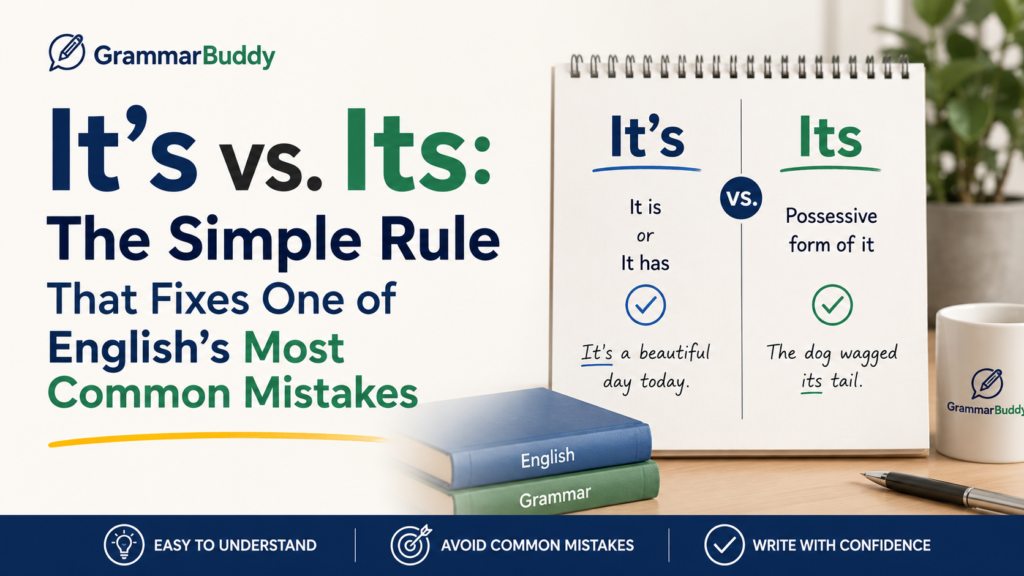

Understanding the difference between “It’s vs. Its” is one of the most common challenges in English grammar, especially for learners, writers, and content creators. The confusion usually arises because both words look almost identical but serve completely different grammatical purposes. “It’s” is a contraction of “it is”or “it has,” while “its” is a possessive form used to show ownership or belonging.
Many people make mistakes in English grammar usage, especially when writing formal content, emails, or academic text. That’s why mastering grammar rules, punctuation accuracy, and possessive pronouns is essential for clear communication. Learning the correct use of apostrophes, avoiding common writing errors, and improving sentence structure can significantly enhance your writing quality.
The confusion between it’s and its usage, English writing skills, grammar correction, and language learning tips often leads to misunderstandings. By focusing on writing clarity, correct word usage, and English language basics, you can avoid these mistakes easily. Practicing grammar exercises, reading examples, and reviewing English vocabulary rules also helps strengthen understanding.
Quick Answer: It’s vs. Its Explained Fast
If you remember nothing else, remember this:
- It’s = it is OR it has
- Its = shows possession (belonging to something)
Examples
- It’s raining → It is raining
- It’s been a long day → It has been a long day
- The dog wagged its tail → possession
That’s the entire rule in its simplest form. Everything else builds on this.
What Does “It’s” Mean? (With Real Usage)
Let’s start with “it’s.”
At its core, it’s is a contraction. That means it combines two words into one by removing letters and replacing them with an apostrophe.
“It’s” can mean two things:
- It is
- It has
Examples in real sentences
- It’s cold outside → It is cold outside
- It’s going to rain later → It is going to rain later
- It’s been a busy week → It has been a busy week
Notice something important. Every time you see it’s, you can expand it.
Quick Test
Try replacing it’s with it is or it has:
- If the sentence still makes sense → ✅ correct
- If it sounds wrong → ❌ use “its” instead
Common Mistake
- ❌ The company updated it’s policy
- ✅ The company updated its policy
Why? Because you can’t say “the company updated it is policy.” That doesn’t work.
What Does “Its” Mean? (Possession Made Simple)
Now let’s look at “its.”
Unlike “it’s,” its does NOT use an apostrophe. That’s where most people get tripped up.
Definition
Its is a possessive determiner.
It shows that something belongs to something else.
Examples
- The cat cleaned its paws
- The company revised its strategy
- The car lost its tire
In each case, “its” shows ownership.
Think of it like this:
- his
- her
- their
- its
None of these use apostrophes. They’re all possessive pronouns.
Why “Its” Has No Apostrophe (The Rule That Confuses Everyone)
Here’s where English gets tricky—and why so many people mix up it’s vs. its.
The expectation
Most people learn early on:
Apostrophe = possession
For example:
- John’s book
- Sarah’s phone
So naturally, people assume:
- ❌ its’ or it’s = possession
But that rule doesn’t apply to pronouns.
The reality
Possessive pronouns never use apostrophes:
- his (not hi’s)
- hers (not her’s)
- theirs (not their’s)
- its (not it’s)
Why?
Because apostrophes in contractions show missing letters, not ownership.
So:
- it’s = it is / it has
- its = already complete (no missing letters)
That’s the key distinction.
It’s vs. Its: Side-by-Side Comparison
Here’s a clear breakdown you can scan in seconds:
| Word | Meaning | Function | Example |
| It’s | It is / It has | Contraction | It’s a beautiful morning |
| Its | Belonging to it | Possessive form | The tree lost its leaves |
The Easiest Trick to Never Get It Wrong Again
If you want a foolproof method, use this:
The “It Is” Test
Replace the word with “it is”.
- If the sentence still works → use it’s
- If it doesn’t → use its
Examples
- It’s a good idea → It is a good idea ✅
- The dog wagged its tail → The dog wagged it is tail ❌
Another example
- It’s been difficult → It has been difficult ✅
- The machine lost its power → It has power ❌
This trick works almost every time.
Common Mistakes You Should Avoid
Even confident writers slip into these patterns. Let’s fix them.
Using “it’s” for possession
- ❌ The phone lost it’s battery
- ✅ The phone lost its battery
Forgetting contraction meaning
- ❌ Its going to rain
- ✅ It’s going to rain
Overcorrecting
Some people avoid “it’s” entirely to stay safe. That creates awkward writing.
- ❌ It is been a long day
- ✅ It’s been a long day
Quick Correction Table
| Incorrect | Correct |
| Its raining outside | It’s raining outside |
| The company changed it’s policy | The company changed its policy |
| Its been a great experience | It’s been a great experience |
Real-Life Examples in Context
Understanding rules is one thing. Seeing them in action is what makes them stick.
Email Writing
- ❌ The team updated it’s schedule
- ✅ The team updated its schedule
Read More: Disoriented vs. Disorientated: What’s the Real Difference (And Which Should You Use)?
Social Media
- ❌ Its amazing how fast time flies
- ✅ It’s amazing how fast time flies
Academic Writing
- ❌ The system adjusts it’s output automatically
- ✅ The system adjusts its output automatically
Professional Communication
Small grammar mistakes affect credibility.
A recruiter scanning resumes might not consciously analyze grammar—but errors still create friction. Clean writing builds trust.
Memory Hacks That Actually Work
You don’t need complex grammar theory. These quick tricks stick.
Simple Rules
- Apostrophe = missing letters
- No apostrophe = possession (for pronouns)
Sticky Phrase
“If you can say ‘it is,’ use it’s. If not, use its.”
Comparison Trick
Think:
- his → its
- not hi’s → not it’s
That parallel makes the rule feel natural.
Practice Section: Test Yourself
Try these before checking answers.
Fill in the blanks
- ___ going to be a great day
- The company updated ___ website
- ___ been a long journey
- The dog chased ___ tail
- ___ hard to believe
Answers
- It’s
- its
- It’s
- its
- It’s
If you got most right, you’re already improving.
Advanced Insight: When Style Matters
Understanding its vs. it’s also helps you adjust tone.
Formal Writing
In academic or formal contexts:
- Avoid contractions
- Use “it is” instead of “it’s”
Informal Writing
In blogs, emails, and conversations:
- Contractions feel natural
- “It’s” improves flow
Example
- Formal: It is essential to understand grammar rules
- Informal: It’s important to get this right
Both are correct. The context decides.
Case Study: How One Apostrophe Changed Meaning
Scenario
A company posted this sentence on their website:
“The brand is known for it’s quality.”
What went wrong
- “It’s” = it is
- So the sentence reads: “The brand is known for it is quality”
That doesn’t make sense.
Correct version
“The brand is known for its quality.”
Impact
Small error. Big perception shift.
Users may not analyze the grammar consciously, yet it still affects how polished and trustworthy the brand appears.
Why This Mistake Is So Common
Let’s be honest—English isn’t always logical.
Key reasons people struggle
- Apostrophes often signal possession
- Pronouns break that pattern
- Fast typing leads to autopilot errors
- Spellcheck doesn’t always catch it
Fact
Grammar tools often miss its vs. it’s because both are valid words.
That’s why understanding the rule matters more than relying on software.
Expert Insight
“Clarity in writing comes from mastering small rules, not just big ideas.”
That applies perfectly here. Fixing it’s vs. its instantly sharpens your writing.
Internal Grammar Connections
If you’re learning this rule, you’ll benefit from related ones:
- Your vs. You’re
- Their vs. There vs. They’re
- Apostrophe usage rules
These follow similar patterns. Master one, and the others become easier.
Final Summary: It’s vs. Its Made Simple
Let’s lock it in.
- It’s = it is / it has
- Its = possession
One Rule to Remember
Use the “it is” test:
- Works → use it’s
- Doesn’t → use its
That’s it. No complicated grammar needed.
Conclusion
In conclusion, the difference between it’s and its is simple once you understand the rule: it’s = it is/it has and its = possession. Regular practice of grammar rules and attention to detail can eliminate this common mistake from your writing.
FAQs
What is the difference between it’s and its?
“It’s” is a contraction of “it is” or “it has,” while “its” shows possession or belonging.
Why is it’s vs its confusing?
They sound the same and look similar, but they have completely different grammatical functions.
How can I remember it’s vs its easily?
Remember: if you can replace it with “it is,” use “it’s.” Otherwise, use “its.”
Is apostrophe used in its?
No, “its” does not use an apostrophe when showing ownership.