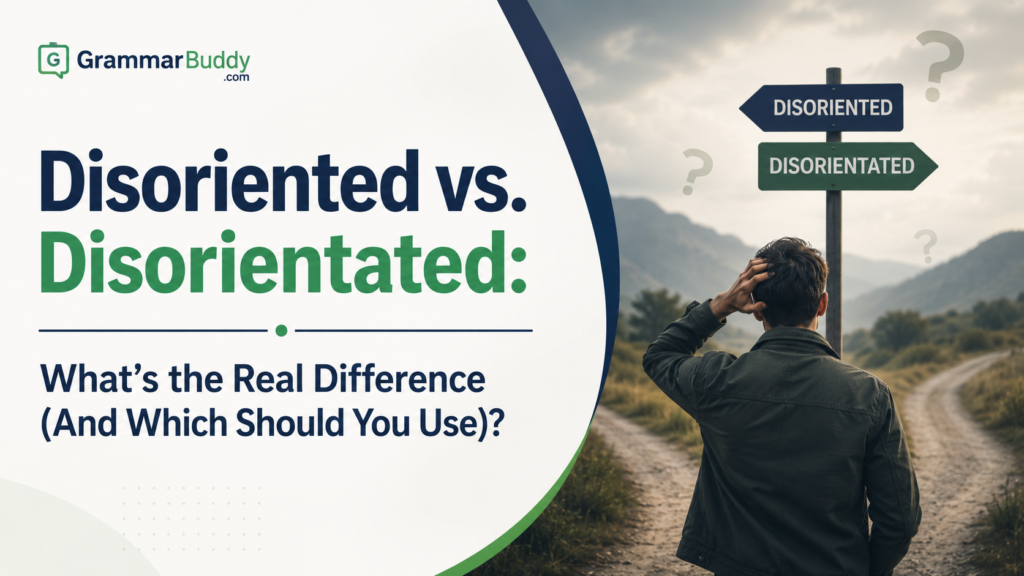

The confusion between Disoriented vs Disorientated is a common issue in English grammar, especially for learners and even native speakers. Both words are widely used to describe a state of confusion, mental imbalance, or loss of direction, but their usage can vary depending on regional English preferences. In American English, disoriented is the more commonly accepted form, while British English often uses both disoriented and disorientated interchangeably. Understanding the difference helps improve language accuracy, communication clarity, and overall writing skills.
The term disoriented typically refers to someone feeling lost, confused, or unable to think clearly, often due to stress, illness, or sudden environmental changes. On the other hand, disorientated carries a similar meaning but is sometimes considered slightly more formal or traditional in British usage.
Despite these subtle differences, both words convey a sense of mental confusion, lack of direction, and spatial uncertainty.Grasping the correct usage of Disoriented vs Disorientated is essential for students, writers, and professionals who aim for precise English grammar, improved vocabulary skills, and effective communication fluency in both spoken and written contexts.
Why “Disoriented vs. Disorientated” Confuses So Many Writers
At first glance, the difference looks minor. Just a few extra letters. But in writing, small details matter.
Here’s why people get stuck:
- Both words appear in dictionaries
- Both sound natural when spoken
- Spellcheck tools often accept both
- Different regions prefer different forms
Now add exams, professional writing, or content into the mix. Suddenly, choosing the “wrong” version can feel risky.
The confusion isn’t about meaning. It’s about usage.
Quick Answer: Disoriented vs. Disorientated
If you’re in a hurry, here’s the clear takeaway:
- Disoriented → Preferred in American English
- Disorientated → More common in British English
- Meaning → Exactly the same
Side-by-Side Comparison
| Feature | Disoriented | Disorientated |
| Meaning | Mentally confused | Mentally confused |
| Region | United States | United Kingdom, others |
| Formality | Standard | Standard |
| Length | Shorter | Longer |
| Usage Frequency | Higher globally | Less common globally |
Bottom line: You’re choosing a style, not a meaning.
What Does “Disoriented” Mean?
The word disoriented describes a state where someone loses their sense of direction, awareness, or clarity.
It can refer to both physical confusion and mental disconnection.
Core Meaning
- Unable to think clearly
- Unsure of surroundings
- Temporarily confused
Common Situations
You’ll often see “disoriented” used in:
- Travel fatigue (jet lag)
- Medical conditions
- Sudden shocks or surprises
- Stress or anxiety moments
Examples in Context
- After the long flight, you may feel disoriented for a few hours.
- The loud crash left him briefly disoriented.
- Patients sometimes appear disoriented after surgery.
Why Americans Prefer “Disoriented”
American English leans toward shorter, more direct forms. Words tend to lose extra syllables over time.
Think of it like trimming excess weight. Cleaner. Faster. Easier to read.
What Does “Disorientated” Mean?
Now here’s the twist: disorientated means exactly the same thing.
There’s no hidden nuance. No subtle shift. No special context.
Definition
- Confused or unable to think clearly
- Lacking awareness of direction or surroundings
Examples in Context
- She felt disorientated after waking up suddenly.
- The maze left visitors completely disorientated.
- He became disorientated in the unfamiliar city.
Why It Exists
The longer form comes from the verb “orientate”, which is more common in British English.
So naturally:
- Orientate → Disorientate → Disorientated
Is There Any Real Difference Between Disoriented and Disorientated?
Let’s be direct.
There is no difference in meaning, tone, or correctness.
The only real difference is:
Regional preference
Key Insight
- Americans say: disoriented
- Brits often say: disorientated
That’s it.
Similar Word Patterns
This isn’t unusual. English has many pairs like this:
| American English | British English |
| Orient | Orientate |
| Customize | Customise |
| Organize | Organise |
| Analyze | Analyse |
Language evolves differently across regions. Neither version is “wrong.”
Why Do Two Versions Exist? (Simple Explanation)
To understand this fully, you need to look at how English evolves.
The Root Word: “Orient”
Originally, “orient” meant:
- To align
- To find direction
From there, two paths developed:
Path One (American Style)
- Orient
- Disorient
- Disoriented
Path Two (British Style)
- Orientate
- Disorientate
- Disorientated
Important Insight
British English often adds “-ate” endings, while American English tends to simplify.
This pattern repeats across dozens of words.
Disoriented vs. Disorientated in American vs. British English
Let’s break it down clearly.
American English Usage
- Strong preference for disoriented
- “Disorientated” sounds slightly unusual or overly formal
British English Usage
- Uses both forms
- Slight preference for disorientated
- “Disoriented” is still widely understood
Global Usage Trends
| Region | Preferred Form |
| United States | Disoriented |
| United Kingdom | Disorientated |
| Canada | Mixed |
| Australia | Mixed |
| International SEO | Disoriented |
Practical Tip
If your audience is global, choose “disoriented”. It’s shorter and more widely recognized.
Which One Should You Use? (Clear, Practical Advice)
This is where most writers overthink things. You don’t need to.
Use “Disoriented” When:
- Writing for a US audience
- Creating SEO content
- You want a clean, modern tone
Use “Disorientated” When:
- Writing for a UK audience
- Matching British spelling standards
- Following a specific style guide
Golden Rule
Consistency matters more than choice.
Don’t switch between the two in the same article. It looks sloppy and confuses readers.
Common Mistakes to Avoid
Even though the difference is simple, writers still make avoidable errors.
Read More: Learned vs. Learnt: What’s Correct in American English? The Complete Guide
Mixing Both Forms
Using both words in the same piece creates inconsistency.
❌ Incorrect:
- He felt disoriented, then later disorientated again.
✔ Correct:
- Stick to one version throughout.
Assuming One Is Incorrect
Some people think “disorientated” is wrong.
It isn’t.
Both are fully accepted in standard English.
Overcomplicating the Choice
Writers often pause too long deciding which to use.
Don’t.
Pick based on your audience and move on.
Using the Wrong Verb Form
Be careful with related verbs:
| Incorrect (US context) | Correct (US context) |
| Disorientate | Disorient |
| Disorientated | Disoriented |
Real-Life Usage Examples (Side-by-Side)
Seeing both versions in action makes the difference clearer.
| Context | American English | British English |
| Travel | I felt disoriented after landing | I felt disorientated after landing |
| Medical | The patient is disoriented | The patient is disorientated |
| Casual | That ride made me disoriented | That ride made me disorientated |
| Work | He seemed disoriented in the meeting | He seemed disorientated in the meeting |
Case Study: Which Version Performs Better in?
Let’s look at this from a practical, data-driven angle.
Search Behavior Insight
- “Disoriented” gets higher search volume globally
- “Disorientated” has lower competition, but fewer searches
What This Means for You
If you’re writing content to rank:
- Use disoriented as your primary keyword
- Include disorientated naturally for coverage
Smart SEO Strategy
- Title: Use Disoriented vs. Disorientated
- Headings: Include both variations
- Body: Prioritize “disoriented”
This approach captures both audiences without keyword stuffing.
Quick Memory Trick You’ll Actually Remember
Forget complicated grammar rules.
Use this:
- Shorter word → American English
- Longer word → British English
So:
- Disoriented = US
- Disorientated = UK
Simple. Reliable. Easy to recall under pressure.
Expert Insight on Language Variation
“Variation in English isn’t a flaw. It’s a reflection of how language adapts to culture, geography, and time.”
Writers who understand this don’t chase “perfect” words. They choose appropriate ones.
Conclusion
In conclusion, the difference between Disoriented vs Disorientated is subtle but important for understanding regional language preferences.
While both terms describe a state of confusion or loss of direction, disoriented is more widely used in American English, whereas disorientated is more common in British English. Knowing this distinction helps improve writing accuracy and language comprehension.
FAQs
What is the meaning of disoriented?
Disoriented means feeling confused, lost, or unable to think clearly, often due to stress or unfamiliar surroundings.
Is disorientated correct English?
Yes, disorientated is correct, mainly used in British English, though less common in American English.
What is the main difference between disoriented and disorientated?
The main difference lies in usage preference: disoriented is American English, while disorientated is British English.
Can I use both words interchangeably?
Yes, both can be used interchangeably in most contexts, depending on your audience and writing style.