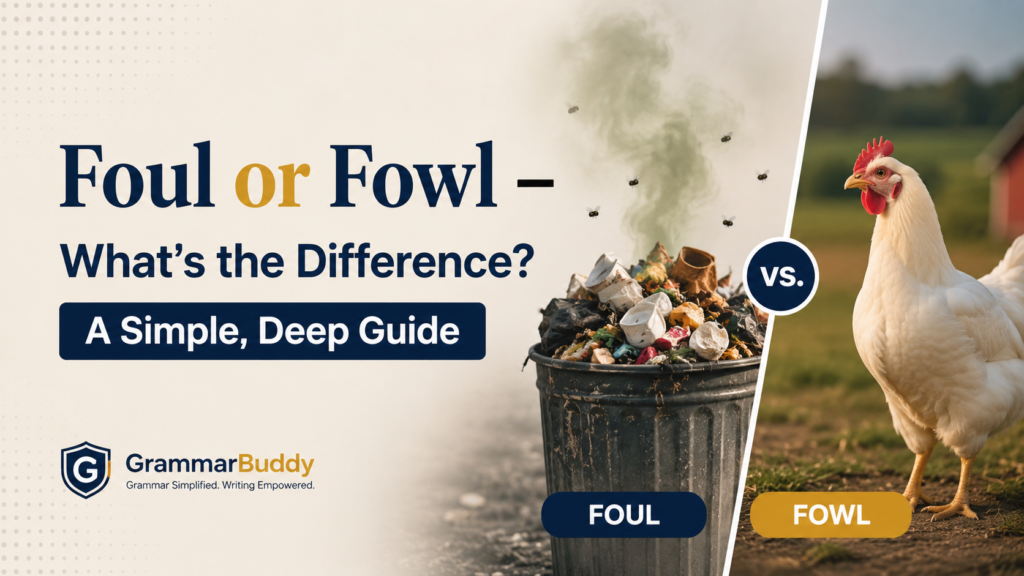

Understanding the difference between foul and fowl is essential for clear and effective communication in English. Although these two words sound identical, they carry completely different meanings and are used in distinct contexts. The word foul is commonly associated with something unpleasant, dirty, or morally wrong. It is also widely used in sports to describe a violation of rules.
On the other hand, fowl refers specifically to birds, particularly domesticated ones like chickens, ducks, or turkeys. Because of their similar pronunciation, many learners and even native speakers sometimes confuse these terms in writing.To master Foul or Fowl, it is helpful to explore their meanings, usage, and examples in everyday language.
Recognizing the difference not only improves vocabulary but also enhances writing accuracy. Some commonly related LSI keywords include homophones in English, difference between foul and fowl, common English mistakes, English vocabulary tips, and word usage examples. By paying attention to context, you can easily determine which word fits your sentence correctly. Learning such distinctions is a crucial step toward fluency and confidence in English communication, especially for students, writers, and language enthusiasts.
Foul or Fowl – The Quick, Clear Difference
Before diving deep, here’s the simplest explanation you’ll ever get:
- Foul = something bad, dirty, offensive, or against the rules
- Fowl = birds, especially chickens, ducks, turkeys, and similar poultry
That’s it. One belongs to problems and violations. The other belongs to farms and food.
But of course, the real magic is in the details.
Foul or Fowl: Why People Get Confused So Easily
Let’s be honest—English spelling isn’t always friendly.
The words foul and fowl are called homophones or near-homophones. That means they sound almost the same but carry totally different meanings.
Here’s why confusion happens:
- They both use “owl-like” pronunciation
- They appear in everyday speech
- Spellcheck doesn’t always catch misuse in spoken writing
- Context is often missing when people learn them casually
A simple mistake like writing “fowl language” instead of “foul language” can completely change the meaning—and make your sentence look odd or incorrect.
What Does “Foul” Mean? (Deep Breakdown of Meaning)
The word foul is flexible. It appears in sports, daily conversation, weather reports, and even emotional expressions.
At its core, it always points toward something negative, unpleasant, or against rules.
Foul in Everyday Life
In daily conversation, foul often describes something unpleasant or offensive.
You might hear:
- Foul smell – something that stinks badly
- Foul taste – food that has gone bad
- Foul language – rude or offensive words
👉 Example:
- The garbage had a foul smell after sitting in the sun.
This usage connects directly to human senses—smell, taste, and hearing.
Foul in Sports (Very Important Usage)
Sports use the word foul in a very specific way.
A foul means breaking the rules during a game.
Common examples:
- Basketball: illegal contact or blocking
- Football (soccer): unfair tackle or handball
- Cricket: illegal bowling action or obstruction
👉 Example:
- The referee called a foul after the defender tripped the striker.
In competitive sports, fouls can lead to:
- Free throws
- Penalty kicks
- Yellow or red cards
- Disqualification in extreme cases
So here, foul doesn’t mean “dirty smell”—it means unfair action.
Foul in Weather and Conditions
Sometimes foul describes harsh or unpleasant conditions.
- Foul weather = stormy, dangerous weather
- Foul seas = rough ocean conditions
👉 Example:
- The sailors delayed the trip due to foul weather.
This usage paints a picture of nature not cooperating.
Foul in Emotions and Behavior
We also use foul to describe actions that feel morally wrong.
- Foul behavior = unethical or disgusting actions
- Foul mood = irritated or angry emotional state
👉 Example:
- He was in a foul mood after losing the match.
Quick Examples of “Foul” in Sentences
Here are simple, real-world uses:
- The room had a foul smell after the spill.
- The player committed a foul in the last minute.
- She used foul language during the argument.
- The ship struggled through foul weather.
What Does “Fowl” Mean? (Simple but Detailed Explanation)
Now let’s switch to the calmer word: fowl.
Unlike foul, this one has nothing to do with negativity.
Fowl refers to birds, especially those raised for food or farming.
Think:
- Chickens
- Ducks
- Turkeys
- Geese
These are all considered fowl.
Types of Fowl
Fowl can be grouped into categories depending on usage:
Domestic Fowl
- Chickens
- Ducks
- Geese
- Turkeys
Game Fowl
- Wild birds hunted for food
- Examples include pheasants and quails
Fowl in Farming and Agriculture
Farmers use the term fowl when talking about bird livestock.
Why?
Because it groups edible birds under one category.
👉 Example:
- The farmer raised fowl for both eggs and meat production.
In agriculture, fowl plays a huge economic role:
- Eggs from chickens
- Meat from chickens and turkeys
- Duck farming in wetland regions
Fowl in Cooking
Chefs also use the term fowl when describing poultry dishes.
You might see:
- Roast fowl
- Stuffed fowl
- Grilled fowl dishes
👉 Example:
- The restaurant served roasted fowl with herbs and garlic.
It sounds more formal than just saying “chicken.”
Examples of “Fowl” in Sentences
- The farm specializes in raising fowl for export.
- Wild fowl gathered near the lake.
- The recipe uses mixed fowl for rich flavor.
Read More: Masonary vs Masonry – Which Is Correct? Meaning, Difference
Foul vs Fowl: Side-by-Side Comparison Table
Let’s make this crystal clear.
| Feature | Foul | Fowl |
| Meaning | Bad, dirty, offensive, unfair | Birds (especially poultry) |
| Part of Speech | Adjective / noun | Noun |
| Usage Areas | Sports, behavior, smell, weather | Farming, cooking, wildlife |
| Emotional Tone | Negative | Neutral |
| Example | foul smell, foul play | roasted fowl, wild fowl |
Easy Memory Trick to Never Confuse Foul and Fowl Again
Here’s a simple trick that actually works:
1. Think “Foul = Fault”
- Both feel negative
- Both involve something wrong
- Helps you remember “bad situations”
2. Think “Fowl = Feathered Animal”
- Birds have feathers
- Fowl sounds like “owl” (a bird)
👉 Quick mental shortcut:
- Foul = bad
- Fowl = bird
Common Mistakes People Make with Foul or Fowl
Even native speakers slip up sometimes.
Here are the most common errors:
- ❌ “fowl language” instead of foul language
- ❌ “fowl smell” instead of foul smell
- ❌ confusing sports commentary terms
- ❌ misusing “foul play” in writing
These mistakes usually happen when people rely on sound instead of meaning.
Real-Life Usage Scenarios (Where You Actually See These Words)
Let’s move beyond definitions and look at real-life usage.
In Sports Commentary
Commentators use foul constantly.
👉 Example:
- “That’s a clear foul by the defender!”
Here, it signals rule-breaking instantly.
In Cooking and Restaurants
Chefs and food writers use fowl to sound professional.
👉 Example:
- “The dish features slow-roasted fowl with seasonal herbs.”
It sounds more refined than just saying chicken.
In Everyday Conversation
You’ll hear both words naturally:
- “That was a foul move.”
- “We bought fresh fowl from the market.”
Why English Has Words Like Foul and Fowl
English evolved from multiple languages—Latin, French, Germanic roots—and that mix created similar-sounding words with different meanings.
This leads to:
- Homophones (same sound, different meaning)
- Irregular spelling rules
- Context-heavy understanding
So instead of memorizing blindly, understanding context works better.
Quick Practice Quiz: Foul or Fowl?
Try these:
- The referee called a ___ on the player.
- The chef prepared roasted ___.
- That was a ___ smell coming from the fridge.
- Wild ___ flew over the lake.
Answers:
- Foul
- Fowl
- Foul
- Fowl
Case Study: How One Word Changes Meaning Completely
Let’s look at a simple real-world mistake.
A restaurant menu once listed:
“Grilled foul special”
Customers were confused and joked online that the restaurant served “bad food on purpose.”
What they meant was:
“Grilled fowl special”
One missing letter changed the entire meaning and brand perception.
This shows why spelling accuracy matters in professional writing.
Foul or Fowl: Final Simple Rule to Remember
If you forget everything else, just keep this:
If it’s dirty, wrong, or unfair—it’s foul.
If it has feathers and flies—it’s fowl.
Short. Clean. Easy.
Conclusion
In summary, the confusion between Foul or Fowl arises mainly due to their identical pronunciation, but their meanings are entirely different. Foul relates to something unpleasant, offensive, or a rule violation, while fowl refers to birds.
Understanding this distinction helps you avoid common errors and improves both your writing and speaking skills. With practice and attention to context, using these words correctly becomes second nature.
FAQs
What is the main difference between foul and fowl?
The main difference is that foul describes something unpleasant or wrong, while fowl refers to birds.
Why do people confuse foul and fowl?
People confuse them because they are homophones in English, meaning they sound the same but have different meanings.
Can foul be used in sports?
Yes, foul is commonly used in sports to indicate a violation of rules.
Is fowl used in modern English?
Yes, but it is mostly used in formal or agricultural contexts when referring to birds.
How can I remember the difference between foul and fowl?
Associate fowl with birds (both have “ow” like “owl”), and foul with something unpleasant or wrong.