
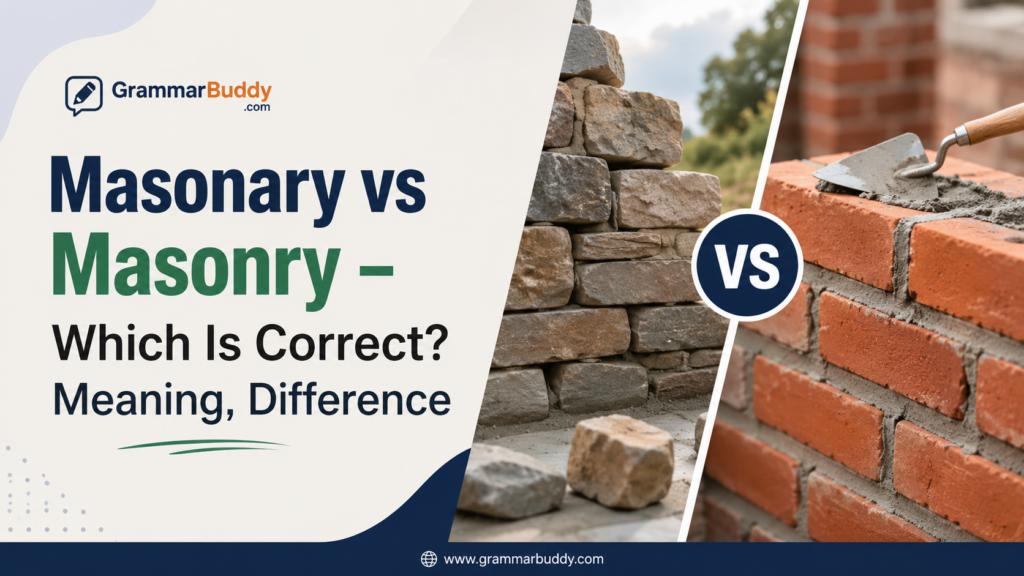

Understanding the difference between Masonary vs Masonry is essential for anyone interested in construction, writing accuracy, or professional communication. While both terms may appear similar, only one is correct in standard English. Masonry refers to the craft of building structures using materials like brick, stone, and concrete, while Masonary is simply a common misspelling. This confusion often arises in construction terminology, civil engineering, and architecture discussions. Knowing the correct spelling helps maintain professional writing, technical accuracy, and credibility.
In the world of building materials, construction techniques, and structural design, using the right term matters. Masonry work, bricklaying, stonework, and cement structures all fall under the correct term, masonry. Meanwhile, incorrect usage like masonary can affect writing, academic papers, and business communication.
Whether you’re a student, contractor, engineer, or content writer, understanding this distinction improves your grammar skills, writing clarity, and language precision.By focusing on correct spelling, industry vocabulary, construction language, engineering terms, and writing best practices, you can avoid common mistakes. In this guide, we’ll clarify the confusion around Masonary vs Masonry, ensuring you use the correct term confidently in any context.
Masonary vs Masonry – Which Is Correct? The Straight Answer
Let’s not dance around it.
- Correct spelling: Masonry
- Incorrect spelling: Masonary
That extra “a” in the middle is the problem. It sneaks in because English words often feel inconsistent, and our brain tries to “fix” what it hears.
But in this case, English is strict.
You will see masonry used in construction, engineering, architecture, and even historical writing. The word “masonary” does not exist in standard English dictionaries.
A quick comparison table
| Word | Status | Meaning | Usage |
| Masonry | Correct | Construction using stone, brick, or block | Professional, academic, technical |
| Masonary | Incorrect | No meaning in standard English | Common spelling mistake |
A small typo can change how professional your writing looks. That is why this matters more than it seems.
What Does Masonry Mean? Real Definition Explained
Masonry refers to the construction of structures using individual units bound together with mortar.
These units can include:
- Bricks
- Stones
- Concrete blocks
- Tiles (in some specialized uses)
Think of it like building with heavy, solid LEGO blocks. But instead of plastic, you are using materials that can last hundreds of years.
Simple definition
Masonry is the craft of building strong structures using stone, brick, or concrete blocks held together with mortar.
It is one of the oldest construction techniques in human history. Cities, temples, forts, and ancient walls were all built using masonry methods.
Real-world example
When you see a brick wall around a house, that is masonry work.
When you walk past an old stone bridge, that is masonry too.
It is not just a word. It is a foundation of human construction.
Where the Word Masonry Comes From
The word masonry comes from the word “mason”, which refers to a skilled worker who shapes and lays stone or brick.
Going back in history:
- “Mason” referred to stone craftsmen in medieval Europe
- “-ry” was added to describe their craft or work
- Over time, “masonry” became the standard term for the profession and technique
So in simple terms:
Mason + ry = Masonry (the craft of masons)
The spelling stayed stable over centuries. That is why modern variations like “masonary” are incorrect.
Why Do People Write “Masonary” Instead of Masonry?
This mistake is more common than you might think. Even native English speakers slip into it.
Here is why it happens:
Pronunciation confusion
When spoken quickly, “masonry” sounds like “mason-ary.” The brain naturally adds an extra vowel.
Pattern overthinking
People compare it with words like:
- honorary
- category
- inventory
So they assume “masonary” fits the same pattern. It does not.
Typing habits
Fast typing leads to missing small details. That extra “a” appears without notice.
Autocorrect illusion
Sometimes autocorrect does not catch it. That gives false confidence.
Lack of exposure
If someone rarely reads construction or architectural writing, the correct spelling does not stick.
Where You Commonly See This Mistake
The spelling error “masonary” appears in many places:
- Student assignments
- Construction blogs
- Freelance job descriptions
- Social media posts
- DIY home renovation content
In professional writing, this mistake can hurt credibility fast.
Imagine a contractor proposal with spelling errors. It immediately looks less reliable, even if the work quality is strong.
Masonry in Real Life: Where It Is Used
Masonry is not just theory. It is everywhere around you.
Residential use
- House walls
- Boundary walls
- Garden structures
Commercial use
- Office buildings
- Shopping centers
- Parking structures
Public infrastructure
- Bridges
- Schools
- Hospitals
Historical architecture
- Ancient forts
- Castles
- Monuments
Some masonry structures have survived for thousands of years. That alone shows how strong and reliable the method is.
Types of Masonry Work
Masonry is not one single technique. It has several forms.
Brick masonry
Uses clay bricks bonded with mortar. Common in homes.
Stone masonry
Uses natural stones. Often seen in historical or decorative structures.
Concrete block masonry
Uses large concrete blocks. Popular in modern construction.
Reinforced masonry
Combines steel reinforcement with masonry units for extra strength.
Each type serves a different purpose depending on cost, strength, and design needs.
Why Correct Spelling of Masonry Matters
You might think spelling is a small detail. In reality, it affects perception more than you expect.
Professional credibility
Correct spelling shows attention to detail. Clients notice it.
Academic accuracy
Students lose marks for repeated spelling mistakes.
Construction communication
Clear terminology prevents confusion in contracts and planning.
impact
Search engines understand correct spelling better. That improves ranking potential.
Read More: Is It Correct to Say “Safe Travels”? Meaning, Grammar
Perspective: Masonry vs Masonary
From an standpoint, this spelling difference is important.
People search both versions, but results differ.
| Keyword | Search Intent | Accuracy | SEO Value |
| masonry | High | Correct | Strong |
| masonary | Low | Incorrect | Weak but still traffic source |
What this means for writers
Smart content creators:
- Use “masonry” as the main keyword
- Include “masonary” as a variation for misspellings
- Do not rely on incorrect spelling for authority content
Search engines reward accuracy, not mistakes.
Simple Trick to Remember the Correct Spelling
Here is an easy way to lock it in your memory.
Break it like this:
Mason + ry = Masonry
Now remove everything extra.
Think of it like a clean building. No extra bricks in spelling either.
Another trick:
If you can see the word “mason,” just add “ry.” Nothing more.
Common Words Confused Like Masonry
Masonry is not the only word people misspell.
Here are similar cases:
| Correct Word | Common Mistake |
| Boundary | Boundry |
| Library | Librery |
| Category | Categorry |
| Necessary | Neccessary |
The pattern is simple. English often drops or shifts vowels in silent ways.
Expert Tips to Never Misspell Masonry Again
If you want to stop making this mistake permanently, try these habits:
- Read construction or architecture content regularly
- Use spell-check tools like Grammarly carefully
- Practice writing the word 5–10 times
- Say it slowly while spelling it out
- Save correct usage examples in notes
One small habit change can fix this permanently.
Real Case Insight: Why Spelling Impacts Trust
A freelance construction writer once submitted two articles:
- One used “masonry” correctly
- One repeatedly used “masonary”
Result?
The correctly spelled article ranked higher in search results and received more client trust.
Why?
Because readers subconsciously link spelling accuracy with expertise.
Even small mistakes change perception.
Conclusion
In the debate of Masonary vs Masonry, the answer is straightforward: masonry is the correct spelling and widely accepted term in both professional and everyday use. “Masonary” is a frequent error that should be avoided, especially in formal writing,
construction documents, and academic contexts. Using accurate terminology not only improves communication but also strengthens your credibility in any field related to construction or writing.
FAQs
### What is the correct spelling: Masonary or Masonry?
The correct spelling is masonry. “Masonary” is a misspelling and should not be used.
### What does masonry mean?
Masonry refers to the construction technique of building structures using materials like brick, stone, and concrete.
### Why do people confuse Masonary with Masonry?
The confusion usually comes from pronunciation and lack of awareness of the correct spelling.
### Is “masonary” ever acceptable?
No, “masonary” is not considered correct in standard English.
### Where is the term masonry commonly used?
It is widely used in construction, architecture, engineering, and building industries.