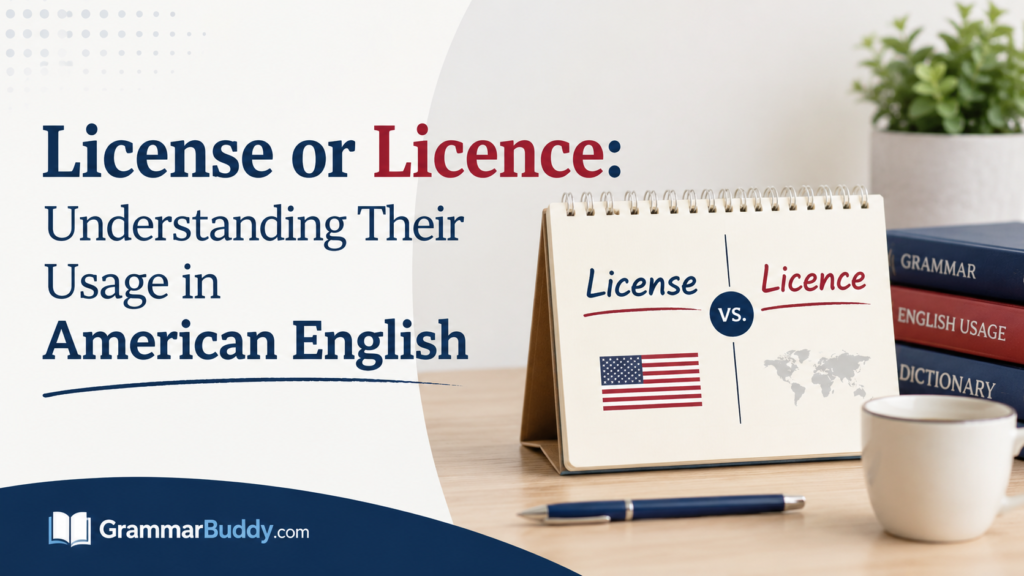

The words license and licence often confuse English learners, writers, and even professionals because they look similar but are used differently in various forms of English. In simple terms, license (American English) is used as both a noun and a verb, while licence (British English) is mainly used as a noun. This difference comes from variations between American English spelling, British English spelling, and grammar rules that evolved over time.
Understanding the correct use of license vs licence, grammar rules, word usage, and spelling differences is important for clear communication, especially in legal, educational, and professional writing. A driving license/licence, for example, refers to an official document that allows a person to operate a vehicle, while to license someone means to give permission legally.
Many learners also search for terms like English language rules, noun and verb forms, legal documents, and correct spelling usage when trying to understand this topic. Knowing when to use each form helps avoid mistakes in exams, job applications, and official writing.In short, mastering the difference between license and licence improves your writing accuracy and strengthens your understanding of modern English usage across different regions.
License or Licence in American English: The Simple Rule You Need First
Let’s not overcomplicate this.
In American English, there is only one correct spelling:
“License” is used for everything—noun and verb.
That’s it.
No exceptions. No alternate spelling. No hidden rule.
So you will always write:
- Driver’s license
- Business license
- To license software
- To license a product
This consistency is intentional. American English simplified many British spellings over time to make writing more uniform and easier to learn.
A quick reality check
If you write “licence” in an American context:
- It will look British
- It may be marked as incorrect in US grammar tools
- It can make your writing appear inconsistent or non-native
A linguist once summed it up perfectly:
“American English removes spelling choices whenever possible to reduce confusion in writing.”
And “license” is a perfect example of that simplification.
License as a Noun in American English (What It Really Means)
When used as a noun, “license” refers to an official permission or document that allows you to do something.
Think of it as a legal green light.
Common real-life examples
You see noun “license” everywhere in daily life:
- Driver’s license → permission to drive legally
- Fishing license → permission to fish in regulated areas
- Business license → permission to operate a business
- Professional license → certification for doctors, lawyers, teachers
Simple definition
A license (noun) = official permission granted by authority.
Example sentences
- I renewed my driver’s license last week.
- She applied for a business license before opening her café.
- You need a fishing license to fish in this lake.
Common mistake
Many writers incorrectly switch to “licence” when writing formally. In American English, that is always wrong.
A simple rule to remember:
If it’s a document or permission, it’s always license.
License as a Verb in American English (Action Meaning Explained Simply)
Now let’s flip it.
When used as a verb, “license” means to give permission officially.
It’s the action of approving or authorizing something.
Simple definition
A license (verb) = to grant permission legally or officially.
Real-world examples
- The government licenses new taxi drivers every year.
- The company licensed its software to schools.
- Hollywood studios license movies to streaming platforms.
Example sentences
- The city licenses food trucks after inspection.
- The brand licensed its logo to a clothing manufacturer.
- Authorities license medical professionals carefully.
Easy way to think about it
If someone is doing the approving, then it’s a verb.
“To license” means “to allow officially.”
License vs Licence: The British English Difference Explained Clearly
Now here’s where things get tricky—but only if you switch between regions.
British English splits the word into two forms:
| Function | American English | British English |
| Noun | License | Licence |
| Verb | License | License |
What this means in practice
- In the US: everything is license
- In the UK:
- Noun → licence
- Verb → license
Example comparison
American English:
- I got my driver’s license.
- The city will license the shop.
British English:
- I got my driving licence.
- The city will license the shop.
Why the difference exists
This goes back to historical spelling patterns from French and Latin influences. British English preserved the noun distinction, while American English streamlined both forms into one.
A simple way to think about it:
British English likes subtle spelling differences.
American English prefers consistency.
Read More: Put Two and Two Together Idiom Definition?
A Simple Memory Trick to Never Confuse License or Licence Again
Let’s make this easy.
If you only write in American English, use this rule:
“In the US, everything is LICENSE.”
Now lock it in with a mental shortcut:
- License = America = One spelling rule only
- Licence = UK = extra “c” for noun
Visual trick
Think of it like this:
- US = Unified spelling system → License
- UK = Split spelling system → Licence / License
Quick recall method
Ask yourself:
“Am I writing for American readers?”
If yes → always license
Common Mistakes People Make with License or Licence
Even strong writers mess this up. Here are the most frequent errors:
Mixing UK and US spelling
Example:
- ❌ I need a driving licence to apply for the job. (US context)
- ✔ I need a driver’s license to apply for the job.
Using “licence” in American documents
This is one of the most common issues in resumes and business writing.
Overthinking noun vs verb
People often pause and try to “analyze grammar” instead of applying the simple rule.
Real fix strategy
- Stick to one English system per document
- For US writing, eliminate “licence” entirely
- Use spell-check tools set to US English
Real-Life Scenarios Where License or Licence Matters
Let’s move beyond grammar rules and see how this plays out in real life.
Driving and transportation
- Driver’s license is required in all US states
- Renewal usually every 4–8 years depending on state
Business operations
- Restaurants must obtain a business license
- Failure to do so can result in fines or closure
Technology and software
- Software companies often license tools instead of selling them outright
- Example: Microsoft licenses Windows to manufacturers
Entertainment industry
- Film studios license content to streaming platforms
- Music rights are licensed to radio stations
Case study: Software licensing in action
A small startup built a project management tool. Instead of selling lifetime access, they chose to license it monthly to schools.
Result:
- Stable recurring income
- Easier customer upgrades
- Controlled usage rights
This shows how “license” isn’t just grammar—it’s a real business concept.
Quick Summary Table: License or Licence at a Glance
| Situation | American English | British English |
| Driving document | License | Licence |
| Permission noun | License | Licence |
| To give permission | License | License |
| Software rights | License | Licence (noun UK) |
Conclusion
The difference between license and licence mainly depends on whether you are using American or British English.
While the meaning stays the same, the spelling and grammatical function change. Understanding this distinction helps you write more professionally and correctly in any context, especially in formal or legal documents.
FAQs
What is the difference between license and licence?
License is American English (noun and verb), while licence is British English (noun only).
Is driving license or licence correct?
Both are correct depending on region: driving license (US) and driving licence (UK).
Can license be used as a verb?
Yes, in American English, license is used as a verb meaning to give permission.
Why are there two spellings?
The difference comes from variations between American and British English spelling systems.
Which one should I use in writing?
Use license for US audiences and licence for UK or Commonwealth audiences.