
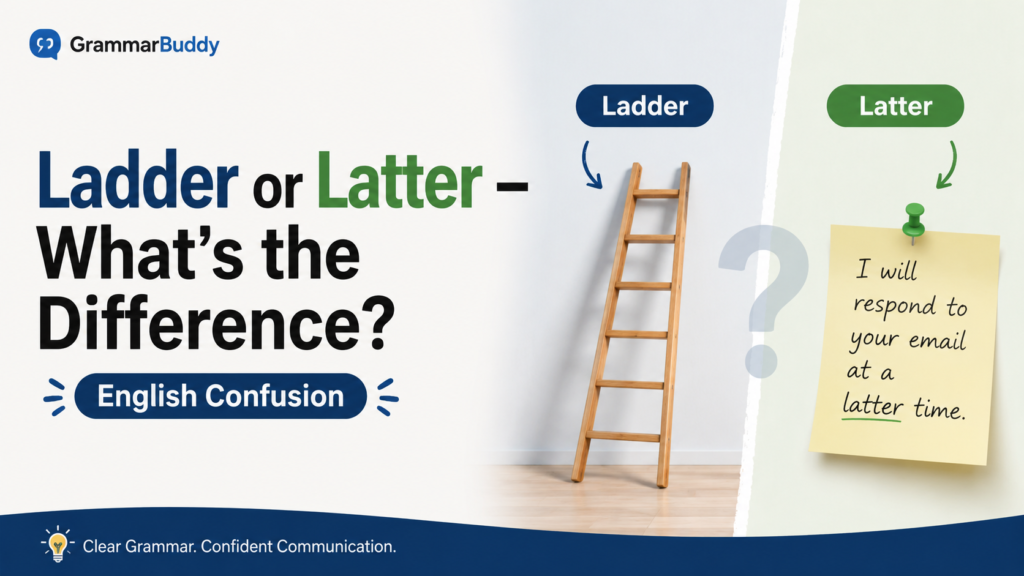

Understanding the difference between Ladder or Latter is essential for clear and accurate English communication, especially for learners who often get confused due to similar pronunciation. The word ladder refers to a physical climbing tool used to reach heights, while latter refers to the second of two things mentioned or the most recent one in a discussion. Many English learners mix these terms in writing and speech, which can lead to misunderstandings.
To master this topic, it is important to focus on grammar rules, word usage, pronunciation differences, contextual meaning, English vocabulary, common mistakes, spelling confusion, sentence structure, and language learning tips. These LSI keywords (and more related terms) help strengthen understanding of how both words function in different situations.
The confusion between ladder or latter often appears in exams, writing tasks, and everyday communication. By learning their correct usage, learners can improve their English fluency, writing accuracy, and communication skills. This guide will help you clearly distinguish between both words using simple explanations and examples.
Why “Ladder” and “Latter” Get Mixed Up So Often
At first glance, the confusion feels harmless. You’re writing fast. Autocorrect doesn’t always help. Then suddenly your sentence looks wrong.
Here’s the real reason this mistake happens:
- Both words sound nearly the same in many accents
- They share similar rhythm and spelling patterns
- They appear in writing at similar complexity levels
But here’s the key truth:
They belong to completely different worlds of meaning.
One helps you climb. The other helps you compare choices.
Simple. Yet easy to mix up.
What Does “Ladder” Mean? (Clear Definition + Real Usage)
A ladder is a physical object used for climbing. You’ve definitely seen one in real life.
Think about it:
- Fixing a ceiling fan
- Painting a tall wall
- Firefighters rescuing someone
A ladder makes height accessible.
Core Meaning
A ladder is a structure with steps (called rungs) used to climb up or down.
Simple Example Sentences
- He climbed the ladder to fix the roof.
- The firefighter extended the ladder toward the window.
- I borrowed a ladder to reach the top shelf.
Metaphorical Use (Important!)
Ladder isn’t just physical. It also describes progress.
- Career ladder → moving up in a job
- Social ladder → gaining status in society
👉 Example:
She worked her way up the corporate ladder step by step.
📌 Interesting fact:
The word ladder comes from Old English and originally referred to steps used for climbing structures.
What Does “Latter” Mean? (Simple but Powerful Concept)
Now let’s switch gears completely.
Latter is not an object. You cannot touch it. You cannot climb it.
Instead, it helps you talk about choices or comparisons.
Core Meaning
Latter refers to the second of two things mentioned.
How It Works in Real Life
Imagine someone says:
- Coffee or tea
- Walking or driving
If you choose the second option, you choose the latter.
Example Sentences
- I like coffee and tea, but I prefer the latter.
- He offered pizza or burgers, and I picked the latter.
- Between studying and gaming, the latter always wins at midnight.
📌 Key rule:
You only use latter when two things are involved.
Bonus Insight
Writers often pair it with former:
- Former = first option
- Latter = second option
Ladder vs Latter – Key Differences at a Glance
Let’s make this crystal clear.
| Feature | Ladder | Latter |
| Meaning | Tool for climbing | Second of two items |
| Type of word | Noun | Adjective/pronoun |
| Usage | Physical or metaphorical structure | Comparison in writing or speech |
| Example | Climb a ladder | Choose the latter option |
| Context | Construction, home, work | Communication, decision-making |
Pronunciation Guide – Why They Sound So Confusing
Here’s where most mistakes happen.
Both words sound extremely similar:
- Ladder → /ˈlædər/
- Latter → /ˈlætər/
In fast speech, they can sound almost identical.
Why your brain gets tricked
- The middle sounds blur together
- The difference between “d” and “t” weakens in speech
- Context usually does the heavy lifting instead of pronunciation
👉 Simple takeaway:
If you only hear it, you often need context to understand it.
Common Mistakes People Make
Let’s look at real-world confusion patterns.
Mistake 1: Writing “ladder” instead of “latter”
- ❌ I prefer the ladder option
- ✅ I prefer the latter option
Mistake 2: Assuming both are interchangeable
They are not. Ever.
Mistake 3: Mishearing in conversation
People often think someone said “ladder” when they actually said “latter.”
Easy Tricks to Remember the Difference
Here are memory hacks that actually work.
1. Visual Trick
- Ladder → imagine climbing steps
- Latter → imagine choosing between two doors
2. Letter Trick
- Latter = “later option” (second choice)
- Both connect to “last” idea
3. Context Trick
Ask yourself:
- Am I talking about an object? → ladder
- Am I comparing two things? → latter
Real-Life Examples That Make It Stick
Ladder in everyday life
- Fixing a light bulb
- Cleaning windows
- Fire rescue operations
👉 Example:
He leaned the ladder against the wall before climbing up carefully.
Latter in decision-making
- Choosing food
- Picking between jobs
- Comparing options in writing
👉 Example:
I had two job offers, and I accepted the latter because it paid better.
Read More: ‘Favourite’ or ‘Favorite’: Unveiling the Spelling Mysteries Behind This Common English Confusion
Why This Confusion Actually Matters in Writing
At first, it may feel like a small spelling issue. But it can change meaning completely.
Why it matters:
- Academic writing demands precision
- Emails can look unprofessional
- Miscommunication can happen in business
📌 Example:
- “I chose the ladder option” → sounds like you picked a tool
- “I chose the latter option” → clear decision
Big difference, right?
Quick Recap – Ladder vs Latter
Let’s lock it in:
- Ladder = something you climb
- Latter = second of two choices
If you remember nothing else, remember this:
👉 One helps you go up. The other helps you decide.
Conclusion
In conclusion, ladder and latter are completely different words with different meanings. One refers to a tool for climbing, while the other refers to the second option or last mentioned item. Understanding their difference helps improve clarity in both spoken and written English.
FAQs
What is the difference between ladder and latter?
Ladder is a climbing tool, while latter refers to the second of two things mentioned.
Why do people confuse ladder and latter?
They sound similar in pronunciation but have completely different meanings and uses.
How can I remember ladder vs latter easily?
Think of ladder = climb and latter = later choice or second option.
Is latter used for more than two things?
No, it is usually used when comparing two things only.