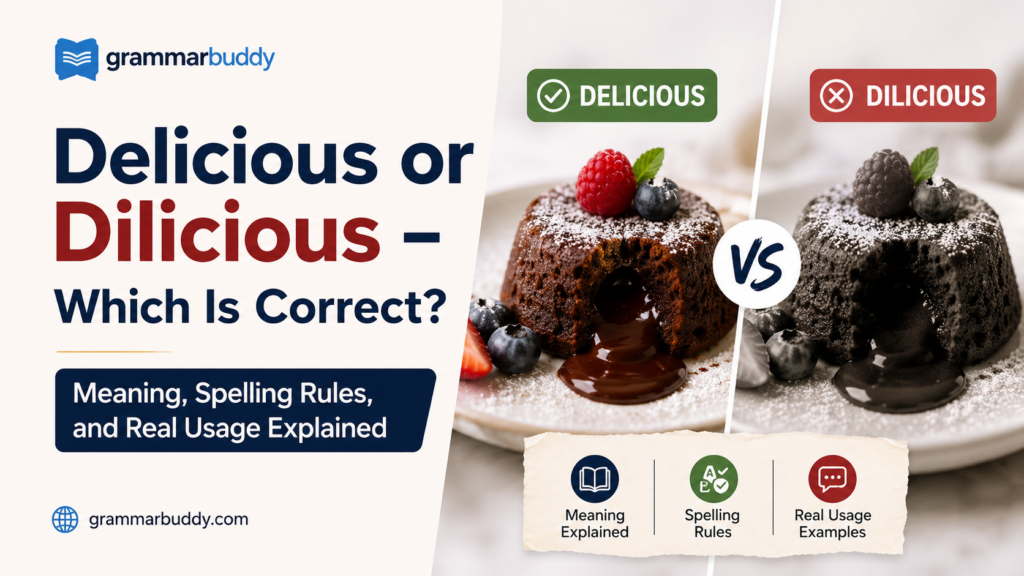

The confusion between “Delicious” or “Dilicious” is a common spelling mistake in English writing that often affects learners, bloggers, and even native speakers. The correct form is “Delicious,” which is widely used in everyday language to describe something tasty, flavorful, or highly enjoyable. However, the incorrect spelling “Dilicious” appears due to phonetic misunderstanding and poor familiarity with English vocabulary, spelling rules, and word formation patterns. Understanding this difference is important for improving English grammar accuracy, enhancing writing skills, and avoiding common spelling errors in academic and professional communication.
The word “Delicious” is often used in food descriptions, restaurant reviews, recipes, and content writing where expressive language matters. On the other hand, “Dilicious” has no official meaning in standard dictionaries, making it a misspelled word rather than a valid term. Learning the correct usage also strengthens language learning skills, boosts writing quality, and improves content credibility.
By mastering such commonly confused words, learners can improve their spelling accuracy, build better communication skills, and develop confidence in writing. Whether you are a student, content creator, or English learner, knowing the difference between these terms ensures clarity and professionalism in your writing.
What Does “Delicious” Actually Mean in English?
The word delicious describes something that gives strong pleasure, especially in taste.
Most people connect it with food, but the meaning goes beyond that.
Core meaning
- Extremely tasty or enjoyable
- Pleasant to the senses
- Something that feels satisfying or delightful
Real-life examples
- The chocolate cake tastes delicious after dinner.
- That mango smoothie is absolutely delicious on a hot day.
- She enjoyed a delicious moment of silence after work.
You can even use it outside food:
- A delicious idea
- A delicious feeling of freedom
- A deliciously calm morning
The word carries emotion. It doesn’t just describe taste—it adds enjoyment.
Is “Dilicious” a Real English Word?
Let’s be very clear here.
“Dilicious” is NOT a recognized English word.
You won’t find it in:
- Oxford English Dictionary
- Merriam-Webster Dictionary
- Cambridge Dictionary
It usually appears because of:
- Typing mistakes on phones
- Auto-correct errors
- Mishearing the pronunciation
- Informal slang spelling online
Why it feels “almost correct”
The word sounds like it could exist because English pronunciation is tricky. When spoken quickly, “delicious” may sound slightly like “dilicious,” especially in casual speech.
But spelling doesn’t follow sound alone—it follows rules and structure.
Why People Mistakenly Write “Dilicious” Instead of “Delicious”
This mistake is more common than you think. It usually comes from a mix of habit, speed, and sound confusion.
Common reasons include:
Typing too fast
Most people write on phones. Fingers move faster than thinking, so letters shift.
Sound-based spelling
English pronunciation often confuses learners. “De” can sound soft, almost like “di” in fast speech.
Influence of slang
Social media encourages playful spelling like:
- “delish”
- “yumlicious”
- “scrumptious”
So people unconsciously assume “dilicious” fits the same pattern.
Auto-correct errors
Sometimes devices “guess” the wrong correction if the word is typed incorrectly multiple times.
Simple Trick to Always Spell “Delicious” Correctly
You don’t need complex grammar rules. Just use memory tricks.
Easy breakdown method
Split the word:
de – li – cious
Say it slowly. It becomes harder to mess up.
Word association trick
Connect it with related words:
- Delight
- Delicate
- Deliver (positive sense of “good”)
All start with “de,” not “di.”
Memory hook
Think of it like this:
“Delicious starts with ‘delight’—because good food brings delight.”
This mental link sticks better than memorizing spelling alone.
Common Misspellings of “Delicious” You Should Avoid
“Dilicious” is not the only mistake. People also write:
| Incorrect Spelling | Why It Happens |
| dilicious | Sound confusion |
| delisious | Letter swapping |
| deliscious | Extra “c” added |
| delishus | slang influence |
| delious | missing letters |
Even small spelling errors can reduce clarity in writing.
How “Delicious” Is Used in Real Communication
The word appears in many contexts, not just cooking.
Food descriptions
- The pasta looks delicious
- That street food smells delicious
Emotional expression
- A delicious sense of relief
- A delicious moment of peace
Marketing and branding
Restaurants and food brands use it heavily:
- “Delicious meals delivered fast”
- “Experience delicious comfort food”
Casual slang
- “That burger was delish!”
- “This cake is sooo delicious 😋”
Notice how “delish” is acceptable slang, but “dilicious” is not.
Read More: Ladder or Latter – What’s the Difference?
Delicious vs Dilicious – Clear Comparison Table
| Feature | Delicious | Dilicious |
| Dictionary status | Official word | Not recognized |
| Meaning | Tasty, enjoyable, pleasing | No meaning |
| Usage | Formal & informal | Only mistaken usage |
| Acceptability | Correct | Incorrect |
| SEO value | High | Zero |
| Example | “The meal is delicious” | “The meal is dilicious” (wrong) |
This makes it easy to see why one belongs in proper writing and the other doesn’t.
Why Spelling “Delicious” Correctly Matters More Than You Think
Spelling isn’t just grammar—it affects communication, credibility, and even online visibility.
In writing and education
Correct spelling shows:
- Strong language skills
- Attention to detail
- Professional communication ability
In SEO and digital content
Search engines understand “delicious” only in its correct form.
If you use “dilicious” in content:
- Google won’t rank it properly
- Users may not find your page
- Your content loses authority
In business communication
Imagine a restaurant website writing:
“Try our dilicious pizza”
It immediately looks unprofessional and hurts trust.
Case Study: How One Spelling Error Impacts Perception
Let’s look at a simple real-world example.
A small bakery once used the slogan:
“Freshly baked dilicious cakes every day”
They noticed:
- Customers laughed at the spelling
- Social media engagement dropped
- People questioned professionalism
After correcting it to:
“Freshly baked delicious cakes every day”
Their brand perception improved instantly.
The lesson is simple:
Small spelling errors create big trust issues.
Where “Delicious” Appears in Modern Culture
The word has a strong presence in daily life, media, and branding.
Food industry
Almost every restaurant uses it:
- Delicious meals
- Delicious flavors
- Delicious desserts
Pop culture and media
You’ll see it in:
- Food shows
- Cooking blogs
- Social media food influencers
Online slang evolution
People shorten it creatively:
- Delish (popular informal version)
- Yumlicious (playful exaggeration)
But again—none replace the correct spelling in formal writing.
Why “Dilicious” Spreads Online
Even though it’s incorrect, it spreads fast on the internet.
Reasons include:
- Viral memes using intentional misspelling
- Casual texting culture
- Autocorrect inconsistencies
- Low attention to spelling on social platforms
Social media often values speed over correctness, which fuels mistakes.
However, that doesn’t make the word valid in formal English.
Expert Linguistic Insight on “Delicious”
Linguists trace “delicious” back to Latin roots:
- Latin: deliciosus
- Meaning: delightful or giving pleasure
Over time, English adapted it into:
- Old French influence → “delicieux”
- Middle English → “delicious”
The structure stayed stable for centuries. That’s why modern spelling remains fixed.
“Dilicious” simply doesn’t connect to any historical form.
Practical Usage Guide for Writers and Students
If you write essays, blogs, or professional content, follow this simple rule:
Always use “delicious” when:
- Writing essays
- Creating blogs
- Posting business content
- Writing emails
- Describing food formally
Avoid “dilicious” completely
Unless you are:
- Writing intentional slang
- Creating a joke or meme (carefully)
Even then, clarity matters more than humor in most cases.
Conclusion
In conclusion, the correct spelling is “Delicious,” while “Dilicious” is simply a misspelling with no standard meaning. Using the correct form improves writing quality, grammar accuracy, and overall communication effectiveness.
FAQs
1. Is “Dilicious” a correct word?
No, “Dilicious” is not a correct English word. The correct spelling is “Delicious.”
2. What does “Delicious” mean?
“Delicious” means something very tasty or extremely pleasant to eat or experience.
3. Why do people write “Dilicious”?
It usually happens due to spelling mistakes or incorrect pronunciation.
4. How can I remember the correct spelling?
Focus on the root word “delight” and remember the correct form “Delicious.”