
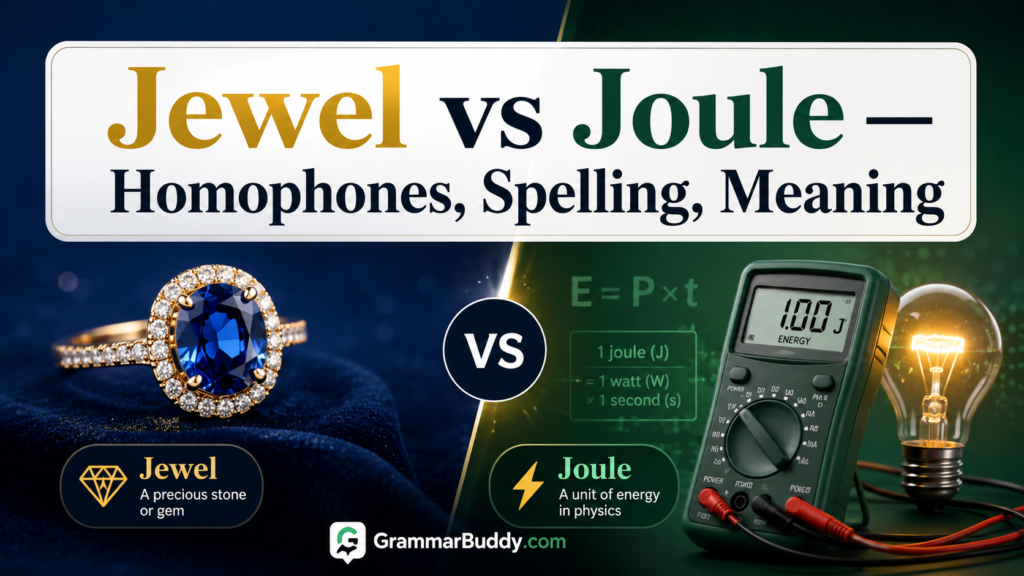

Jewel vs Joule shows SI energy unit joule in International System of Units, Newton force and metre in physics SI unit.In science, a joule is a unit of energy, work, and SI system measurement. It is named after James Prescott Joule, an English physicist, who contributed to the law of thermodynamics. Together with William Thomson, he helped develop the Kelvin scale.
A joule represents energy transferred when a force of one newton moves an object through one metre. It is also linked to electrical systems where current, amp, and ohm resistance interact. Energy is measured in different forms including watt-second, ergs, and foot-pounds, showing how deeply this unit connects physics and real-world energy use.
A joule also appears in electrical terms as energy released when a current of one ampere flows through one ohm resistance for one second. It can represent energy done by a newton force acting through a metre, making it a universal SI unit. Scientists use it to measure work energy, heat, and electrical output. It helps standardize calculations across physics and engineering, ensuring all energy forms are comparable in the International System of Units.
What Does “Jewel” Mean? Definition, Meaning, and Usage
A jewel is something precious, rare, and visually beautiful. Most people connect it with gemstones, but the meaning goes a bit deeper than that.
A jewel can be:
- A natural gemstone like diamond, ruby, sapphire, or emerald
- A crafted piece of jewelry
- Something or someone extremely valuable in a symbolic way
For example:
- “That old library is a hidden jewel of the city.”
- “She is the jewel of her family.”
Here, we’re not talking about diamonds. We’re talking about value and uniqueness.
The word originally came from Old French jouel, meaning ornament or delight. Over time, it became tied to luxury and gemstones.
What Does “Joule” Mean? Scientific Definition Made Simple
Now we switch gears completely.
A joule is a unit of energy used in science, especially physics. It tells you how much energy something uses or transfers.
The simple definition:
One joule is the energy used when a force of one newton moves an object one meter.
That might sound technical, but here’s a simple way to think about it:
- Lifting a small apple = about 1 joule of energy
- Turning on a light bulb = thousands of joules every second
- Charging your phone = measured in millions of joules over time
The joule is named after James Prescott Joule, a physicist who studied energy and proved that energy can change forms but cannot disappear.
That idea is a foundation of modern physics.
Jewel vs Joule — Key Differences at a Glance
Let’s put them side by side so you can clearly see the difference.
| Feature | Jewel | Joule |
| Meaning | Precious stone or valuable object | Unit of energy |
| Field | Jewelry, luxury, art | Physics, science |
| Usage | Descriptive language | Measurement |
| Example | Diamond is a jewel | Energy is measured in joules |
| Symbolism | Beauty, rarity, value | Force, energy, work |
Simple rule:
- Jewel = something you admire
- Joule = something you measure
Why “Jewel” and “Joule” Sound the Same
These two words are homophones, meaning they sound the same but have different meanings and spellings.
English is full of these because:
- It borrows words from many languages
- Pronunciation evolved differently from spelling
- Scientific terms often come from people’s names
- Old words shifted in sound over time
Even though they sound identical today, their origins are completely unrelated.
Common Mistakes People Make with Jewel vs Joule
People mix these words all the time, especially in exams and writing.
Common errors include:
- “Energy is measured in jewels” ❌
- “She has 500 joules in her necklace” ❌
Why does this happen?
- They sound exactly the same
- Fast writing leads to guessing
- Lack of context in sentences
Correct versions:
- Energy is measured in joules ✔
- She wore a beautiful jewel ✔
Easy Memory Tricks to Never Confuse Them Again
Here are simple tricks that actually work:
J for Jewelry
- Jewel = jewelry = beauty = J connection
J for James Joule
- Joule = scientist = physics = energy
Visual trick
- Jewel → imagine a sparkling diamond
- Joule → imagine electricity or energy flow
Context trick
Ask yourself:
- Am I talking about beauty or science?
That alone solves it.
Example Sentences for Clear Understanding
Jewel examples
- The crown was covered in rare jewels.
- That mountain village is a hidden jewel.
- She treated the ring like a priceless jewel.
Joule examples
- The battery stores 2000 joules of energy.
- One joule is a small amount of energy.
- Physics students calculate energy in joules.
Case Study — Why Students Confuse Jewel and Joule
In classrooms, this confusion shows up more than you’d think.
A common exam mistake looks like this:
“The experiment released 300 jewels of energy.”
The student understood the concept but lost marks because of spelling.
Why this happens:
- Listening-based learning makes both words sound identical
- Stress during exams leads to spelling guesses
- Weak context understanding
Lesson:
A tiny spelling mistake can completely change meaning in science.
Read More: Years of Experience vs Years’ Experience: The Complete Guide
Quick Quiz — Test Your Understanding
Try these:
- A diamond ring is a ________
- Energy is measured in ________
- Joule is named after a ________
Answers:
- Jewel
- Joule
- Scientist
Why Understanding Homophones Like Jewel vs Joule Matters
This isn’t just vocabulary practice.
It helps you:
- Write correctly in exams
- Avoid science mistakes
- Improve communication clarity
- Build stronger English skills
- Reduce confusion in technical subjects
Small differences create big accuracy improvements.
Final Thoughts — One Sound, Two Completely Different Worlds
At first, jewel vs joule homophones look like a tiny language detail. But they actually show how powerful context is in English.
One word belongs to:
- Beauty
- Value
- Emotion
The other belongs to:
- Science
- Energy
- Measurement
Same sound. Totally different meaning.
So next time you hear it, pause for a second and ask:
Are we talking about something that sparkles—or something that powers the universe?
That simple check saves you every time.
Conclusion
The concept of the joule is a core part of understanding how energy, work, and force are measured in science. Named after James Prescott Joule, this SI unit connects mechanical physics and electrical systems in a single standard. A joule describes the energy transferred when a force of one newton moves an object through a distance of one metre, making it a clear and practical way to measure physical work. It is also used in electricity, where energy is calculated when an ampere current flows through a resistance of one ohm for a specific time in seconds.
What makes the joule especially important is its universal use across the International System of Units (SI). Whether it is heat energy, mechanical work, or electrical output, everything can be measured in joules for consistency. It also connects to older and related units like ergs, foot-pounds, and watt-seconds, helping scientists compare energy across different systems. This makes the joule a bridge between theory and real-life applications in physics and engineering. Understanding it gives a clearer view of how energy behaves in the natural world.
FAQs
What is a joule in simple terms?
A joule is a unit used to measure energy, work, or heat in the SI system.
Who is James Prescott Joule?
He was an English physicist after whom the joule unit is named.
How is a joule related to force?
One joule is the energy used when a newton force moves an object one metre.
Is joule used in electricity?
Yes, it measures electrical energy when current flows through resistance for time.
What system uses the joule?
The International System of Units (SI) uses joules as the standard energy unit.