
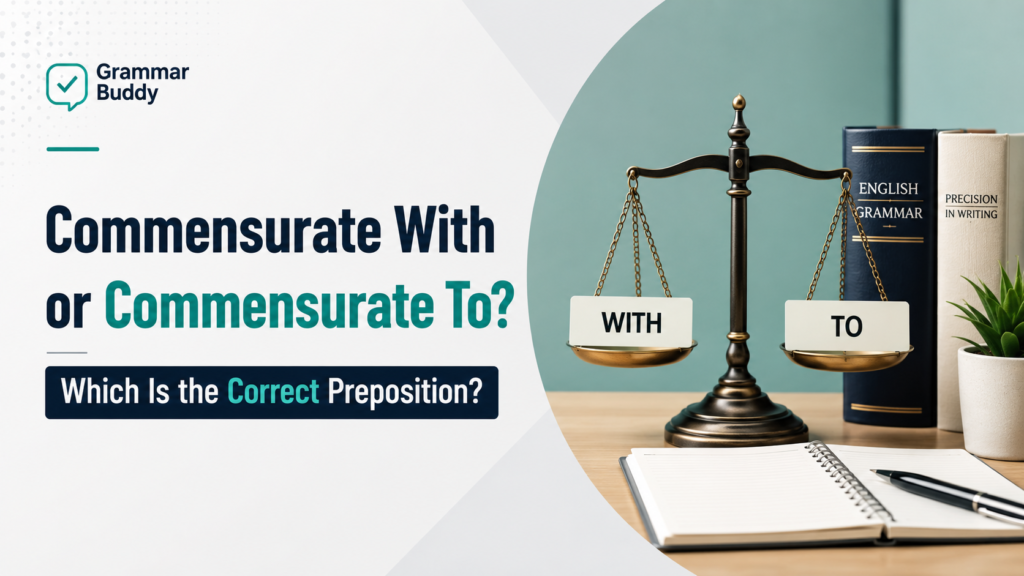

Understanding the difference between commensurate with and commensurate is essential for clear and precise communication. These terms are often used in formal writing, business language, and academic contexts, but many people feel confused about when to use each form. While both relate to the idea of balance, proportion, or equivalence, their grammatical usage differs slightly. Learning how to apply them correctly can significantly improve your writing clarity and professionalism.
The phrase commensurate with is commonly used when comparing one thing to another, showing that something is equal in value, importance, or size. On the other hand, commensurate can stand alone when the comparison is implied or already understood from context. Writers often misuse these forms, leading to awkward or incomplete sentences. That’s why it’s important to understand their structure, usage, and examples in real-life writing.
In this guide, you’ll explore clear definitions, usage rules, grammar tips, common mistakes, writing examples, formal language use, business communication, academic writing style, sentence structure, word comparison, English grammar rules, correct phrasing, professional writing tips, and language clarity techniques. By mastering these, you can confidently use both commensurate with and commensurate in the right context.
Why “Commensurate With or To” Causes Confusion
People usually run into this phrase in formal settings—job ads, legal documents, academic writing, or HR policies.
That’s where the confusion starts.
You’ll see sentences like:
- “Salary commensurate with experience”
- “Pay commensurate to skills” (less common)
Both look right at first glance. English learners often assume both prepositions work because “to” feels natural after many adjectives.
But here’s the twist: only one version is widely accepted in formal English.
By the end of this guide, you’ll know:
- The correct preposition (no guessing)
- Why the mistake happens
- How native speakers actually use it
- Simple memory tricks to never get it wrong again
What Does “Commensurate” Actually Mean?
Before we fix the grammar, you need to understand the word itself.
Commensurate means:
Equal in size, degree, value, or importance compared to something else.
In simpler words:
👉 It means “balanced” or “in proportion.”
Real-world meaning examples
- If effort increases, reward should increase too
- If risk is high, return should be high
- If experience is strong, salary should match it
For example:
- A manager expects a salary commensurate with experience
- A punishment should be commensurate with the crime
According to major dictionaries, it clearly means proportionate or corresponding in degree (Encyclopedia Britannica)
So the idea is always comparison—not direction.
Commensurate With vs Commensurate To — The Core Rule
Here’s the simple truth you need:
The correct and standard form is “commensurate with.”
This is the version used in:
- Academic writing
- Business English
- Legal documents
- Professional communication
For example:
- “The salary is commensurate with experience
- “Pay is commensurate with responsibility.
Why “with” is correct
“Commensurate” expresses balance or equivalence between two things.
So “with” naturally connects them:
- A is equal with B
- Effort is matched with reward
It shows comparison, not movement.
Why “commensurate to” feels wrong
You might still see “commensurate to” in casual writing, but here’s the reality:
- It is not standard in formal English
- It sounds slightly unnatural to native speakers
- It appears due to influence from similar phrases like:
- “proportional to”
- “related to”
- “equal to”
But grammatically and stylistically, “with” dominates modern usage.
Real Examples of Correct Usage
Let’s make it practical. This is how you’ll actually see it used:
Salary and work
- “She expects a salary commensurate with her skills.”
- “Wages should be commensurate with experience.”
Responsibility and roles
- “His duties are commensurate with his rank.”
- “Leadership roles come with commensurate accountability.”
Risk and reward
- “The risk is commensurate with the potential return.”
- “Investments should offer rewards commensurate with risk.”
These are not just textbook examples—they appear in real professional writing daily.
Read More: Fiancé vs Fiancée: Meaning, Difference, Usage, and Everything You Need to Know
Common Mistakes People Make
Even fluent writers slip up here. Let’s look at the usual traps:
Mixing prepositions
- ❌ commensurate to experience
- ✔ commensurate with experience
Overthinking the structure
People try to force logic from other phrases:
- “related to” → they copy “to”
- “proportional to” → they assume same pattern
But commensurate doesn’t behave like those.
Using it too casually
Another mistake is overusing it in informal speech:
- “That’s commensurate with my vibe” (sounds unnatural)
This word belongs in formal or professional contexts, not casual talk.
Commensurate vs Proportionate — Are They the Same?
They’re close cousins, but not identical.
| Feature | Commensurate With | Proportionate To |
| Meaning | Equal in value or degree | Mathematically proportional |
| Usage style | Formal, professional | General, flexible |
| Focus | Balance or fairness | Ratio or scale |
| Example | Salary commensurate with experience | Increase proportional to size |
Simple difference
- Commensurate = fairness and matching quality
- Proportionate = mathematical relationship
So:
- You get a commensurate salary (fairness-based)
- You get a proportionate increase (ratio-based)
Why Native Speakers Always Use “With”
Native usage isn’t random—it follows patterns.
“Commensurate” behaves like adjectives such as:
- consistent with
- compatible with
- aligned with
All of them use “with” because they show connection and equivalence between two things.
Also, English prefers stability in formal phrases. Once “commensurate with” became standard in legal and academic writing, it stayed that way.
So even if “to” feels logical, it simply never became the norm.
Quick Memory Trick to Never Get It Wrong
Here’s a simple mental shortcut:
Commensurate = “matches WITH something”
Think of it like a scale:
- One side is effort
- The other side is reward
- The balance connects with both sides
If it helps, remember:
- “Commensurate WITH = correct match”
- “Commensurate TO = avoid it”
Say it a few times and it sticks.
Real-World Usage in Professional Contexts
This phrase shows up in serious environments.
Human Resources
- Job ads: “Salary commensurate with experience”
- Performance reviews: “Rewards commensurate with output”
Law
- “Punishment must be commensurate with the offense”
Academia
- Research papers use it to describe balanced relationships between variables or outcomes
Business communication
- “Growth should be commensurate with investment”
It’s a signal word—it shows professionalism and precision.
Conclusion
In summary, both commensurate with and commensurate convey the idea of equality or proportion, but their usage depends on sentence structure. Use commensurate with when making a direct comparison, and use commensurate when the comparison is already clear. Mastering this distinction enhances your writing precision, especially in formal, academic, and professional settings. With consistent practice, you can avoid common errors and communicate your ideas more effectively.
FAQs
What does “commensurate with” mean?
It means something is equal in value, size, or importance when compared to something else.
Can “commensurate” be used alone?
Yes, commensurate can be used without “with” when the comparison is already understood.
Which form is more common in formal writing?
Commensurate with is more commonly used in formal and professional writing.
Is it incorrect to say “commensurate to”?
Yes, “commensurate to” is generally considered incorrect. The correct phrase is commensurate with.
Why is this distinction important?
It helps improve clarity, accuracy, and professionalism in writing.