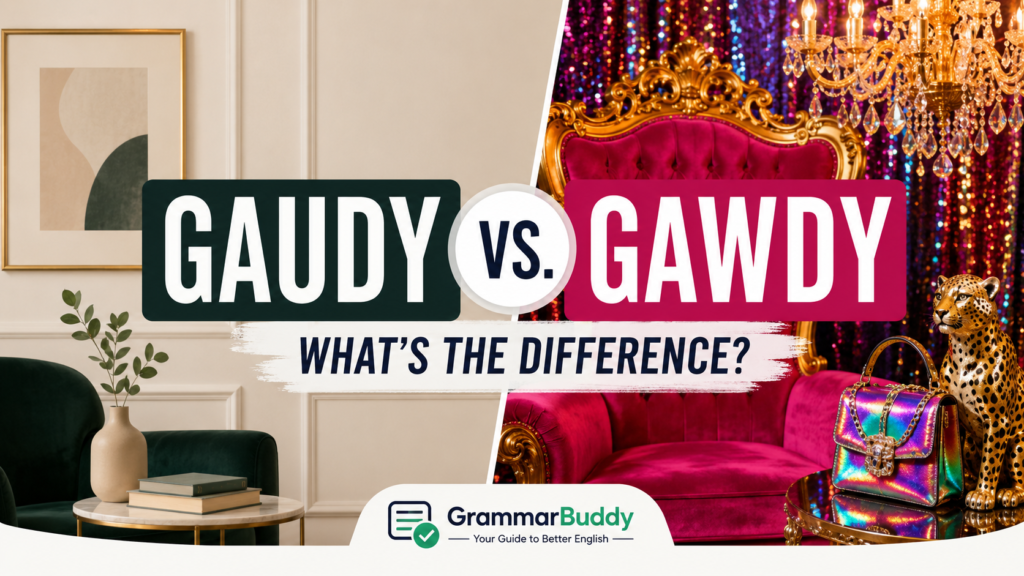

The confusion between Gaudy vs. Gawdy is common in English writing, especially when learners encounter words that sound similar but have different meanings or usage. The correct and widely accepted spelling is Gaudy, which refers to something overly bright, flashy, or excessively decorated in a tasteless way. On the other hand, Gawdy is often considered a misspelling or non-standard variation of the same word. Understanding this difference is important for clear communication and proper grammar usage.
In modern usage, Gaudy is frequently used in contexts such as bright colors, flashy design, excessive decoration, tasteless style, over-the-top fashion, and loud appearance. These LSI keywords help clarify the meaning and improve contextual understanding. Writers, students, and content creators often search for correct spelling, word confusion, English vocabulary, grammar mistakes, homophones, and commonly misused words when studying this topic.
The term is also useful in describing fashion trends, interior design, artistic expression, and visual aesthetics that appear overly exaggerated. Learning the difference between Gaudy and Gawdy helps improve writing accuracy and avoids spelling errors in academic and professional content. Overall, mastering such commonly confused words strengthens English language fluency and vocabulary precision.
What Does Gaudy Mean in English? (Gaudy vs Gawdy Meaning)
The word gaudy describes something overly bright, flashy, or excessively decorated in a way that lacks good taste. It often carries a negative tone, pointing to excess rather than elegance.
Key meaning points:
- Overly colorful or bright
- Excessively decorated
- Lacking subtlety or elegance
- Often visually overwhelming
Example:
A room filled with neon lights and gold furniture may look gaudy instead of stylish.
Is Gawdy a Real Word or Just a Common Mistake?
The spelling “gawdy” is not standard in modern English. It is mostly seen as:
- An outdated spelling variation
- A historical form of “gaudy”
- A common typing or spelling error today
In modern writing, dictionaries and style guides consistently recommend gaudy as the correct form.
Gaudy vs Gawdy – Key Differences Explained
Although they look similar, the difference is important in writing.
| Feature | Gaudy | Gawdy |
| Usage | Standard English | Nonstandard / outdated |
| Correctness | Correct | Incorrect today |
| Meaning | Flashy, tasteless | Same meaning historically |
| Writing use | Formal + informal | Avoid in modern writing |
Simple rule: Always use gaudy.
Why People Confuse Gaudy and Gawdy
The confusion between gaudy vs gawdy happens for a few simple reasons:
- They sound identical when spoken
- Fast typing leads to spelling mistakes
- Older or unreliable sources sometimes use “gawdy”
- Autocorrect doesn’t always fix it
This mix of sound and spelling makes the mistake surprisingly common.
Where Gaudy Is Commonly Used in Real Life
The word gaudy appears in everyday descriptions, especially when judging appearance or design.
Common areas:
- Fashion: overly bright or flashy outfits
- Interior design: excessive decoration
- Art criticism: overly loud visual styles
- Branding: overdone or aggressive design
Example:
“The outfit looked gaudy under the bright stage lights.”
Read More: What Is the Meaning of “Huckleberry”? Definition, Usage, and Examples Explained Simply
Why Gaudy Usually Has a Negative Meaning
The word gaudy often suggests something is trying too hard to impress.
Think of it like this:
Elegant design whispers — gaudy design shouts.
It usually reflects:
- Lack of balance
- Excess decoration
- Poor aesthetic judgment
That’s why it’s rarely used as a compliment.
Easy Ways to Remember Gaudy vs Gawdy
You don’t need complex grammar rules to remember the difference.
Simple tricks:
- Gaudy = modern and correct
- “A U” in gaudy → Awkward and Ugly style
- If unsure, check a dictionary
Quick rule:
If it feels modern, it’s gaudy. If it feels off, it’s probably gawdy.
Examples of Gaudy in Sentences
Here are real-world uses of the correct word:
- The decoration looked gaudy and overwhelming.
- She avoided gaudy jewelry at the formal event.
- The restaurant interior felt gaudy, not elegant.
- His style was bold but slightly gaudy.
Common Mistakes in Using Gaudy vs Gawdy
Many writers accidentally damage their credibility with this small error.
Frequent mistakes:
- Using “gawdy” in formal writing
- Confusing gaudy with “luxurious”
- Overusing the word in descriptions
Real example:
❌ “The room had a gawdy design.”
✔ “The room had a gaudy design.”
Related Words You Should Know
To understand gaudy vs gawdy better, here are related terms:
- Flashy (neutral or slightly positive)
- Garish (strong negative)
- Ostentatious (formal, showing off wealth)
- Over-the-top (informal exaggeration)
Each word changes tone slightly, even if meaning overlaps.
Gaudy vs Similar Words Comparison
Understanding subtle differences helps improve writing accuracy.
| Word | Tone | Meaning Strength |
| Gaudy | Negative | Medium |
| Garish | Very negative | Strong |
| Flashy | Neutral | Low |
| Ostentatious | Formal negative | High |
Quick Usage Guide for Gaudy vs Gawdy
Use this simple checklist:
Do:
- Use gaudy in all modern writing
- Use it for visual description
- Apply it to design, fashion, and aesthetics
Don’t:
- Don’t use gawdy in formal writing
- Don’t confuse it with elegant or luxurious styles
Conclusion
In conclusion, Gaudy is the correct and standard spelling, while Gawdy is generally incorrect or outdated. Knowing this difference helps improve writing clarity and reduces common spelling mistakes. It is especially useful for students, writers, and English learners aiming for accurate communication.
FAQs
1. What is the correct spelling: Gaudy or Gawdy?
Gaudy is the correct spelling. Gawdy is considered incorrect in modern English.
2. What does Gaudy mean?
It means something overly bright, flashy, or excessively decorated in a tasteless way.
3. Is Gawdy used in English?
No, Gawdy is not standard and is usually treated as a misspelling.
4. Where is the word Gaudy commonly used?
It is used in fashion, design, decoration, and descriptions of flashy or exaggerated styles.