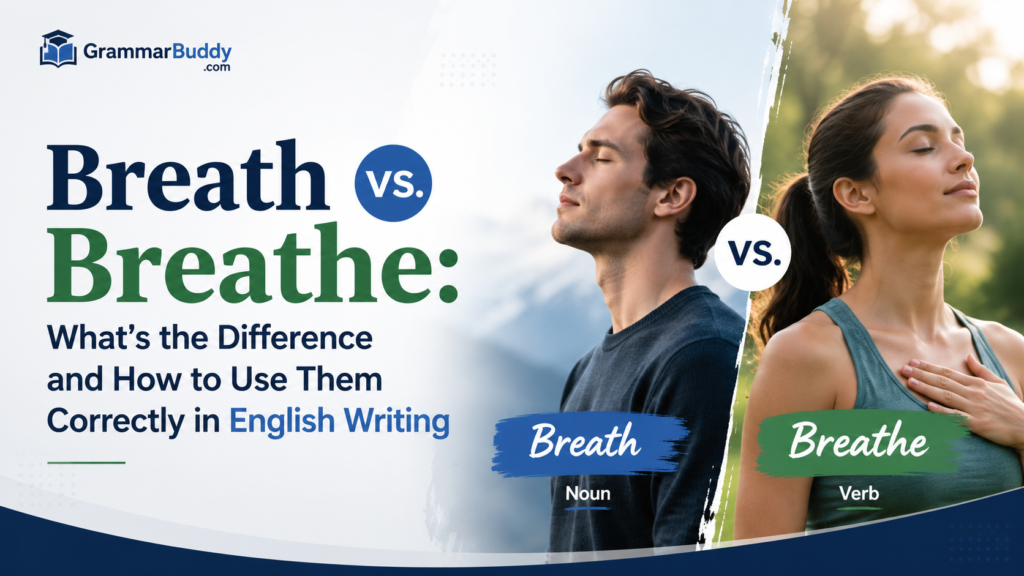

Understanding the difference between Breath vs. Breathe is essential for mastering everyday English grammar and pronunciation. These two words are often confused because they look similar but serve completely different grammatical roles. Breath is a noun that refers to the air you take in and release from your lungs, while breathe is a verb that describes the action of inhaling and exhaling. Many English learners struggle with this difference, especially in writing, speaking, and grammar usage.
In daily communication, correct usage of grammar rules, English vocabulary, parts of speech, sentence structure, and pronunciation tips helps avoid common mistakes. For example, you take a deep breath before speaking, but you must breathe slowly to stay calm. These small distinctions improve both fluency and clarity in English.
Learning the difference between verb vs noun usage, language learning skills, English writing accuracy, and spoken English improvement is important for students, professionals, and ESL learners. Understanding common English mistakes, word confusion, and grammar correction rules can significantly enhance communication skills.By mastering Breath vs. Breathe, you strengthen your foundation in English grammar and build confidence in both writing and speaking.
Why “Breath vs. Breathe” Confuses So Many People
Let’s start with the real issue. People don’t confuse these words because they’re difficult. They confuse them because they look and feel almost the same.
Here’s what makes them tricky:
- Only one extra letter separates them
- Pronunciation is very close in casual speech
- Typing quickly leads to mistakes
- English doesn’t clearly signal noun vs. verb endings in many words
For example, you might quickly write:
- ❌ “Take a deep breathe”
- ❌ “I can’t breath properly”
Both look correct at a glance. But only one form works in each sentence.
A simple truth helps here:
“Breath” is something you have. “Breathe” is something you do.
Once that clicks, most confusion disappears.
What Does “Breath” Mean? (Simple Noun Explanation)
The word breath is a noun. That means it refers to a thing, not an action.
Definition
A breath is the air that goes in and out of your lungs when you inhale or exhale.
Think of it like this
- Breath = a unit of air
- Breath = something you can measure or notice
Everyday examples
- “Take a deep breath before speaking.”
- “His breath smelled like mint.”
- “She held her breath underwater.”
Common expressions using “breath”
People use this word in many natural phrases:
- Hold your breath → stop breathing temporarily
- Out of breath → physically tired from exertion
- Take a breath of fresh air → relax or refresh yourself
- Save your breath → stop talking because it won’t help
Important point
You cannot do breath. You can only have it or take it.
What Does “Breathe” Mean? (Verb Explanation Made Easy)
Now let’s look at breathe.
This word is a verb, which means it shows action.
Definition
To breathe means to take air into your lungs and release it.
Simple idea
- Breathe = the action of breathing
- It describes movement or process
Examples in real life
- “Please breathe slowly and relax.”
- “Fish cannot breathe outside water.”
- “She forgot to breathe during the speech.”
Verb forms of “breathe”
English changes verbs depending on tense:
- Present: breathe
- Past: breathed
- Continuous: breathing
Examples
- “He breathed deeply before jumping.”
- “They are breathing heavily after the run.”
Key takeaway
If something involves action or movement, you use breathe, not breath.
Breath vs. Breathe: The Core Difference Explained Clearly
At the heart of it, the difference is grammatical.
| Word | Type | Meaning | Example Sentence |
| Breath | Noun | Air you inhale or exhale | Take a deep breath. |
| Breathe | Verb | The action of inhaling/exhaling | Please breathe slowly. |
Simple breakdown
- If you can count it or feel it, it’s breath
- If you do it, it’s breathe
Pronunciation tip
- Breath → ends sharply like “death”
- Breathe → softer, with a long “ee” sound
That tiny sound difference helps you remember which is which.
Why These Words Keep Getting Mixed Up
Even advanced learners mix them up. Here’s why:
1. Spelling similarity
Only one letter changes, which makes fast writing risky.
2. Speaking habits
In casual speech, people don’t always emphasize the “e” sound clearly.
3. Typing speed
When typing quickly, your brain often auto-completes incorrectly.
4. Learning patterns
English doesn’t always follow strict noun/verb patterns, so learners rely on memory instead of logic.
Real-life example
A student might write in an essay:
- ❌ “The patient cannot breath properly”
But under exam pressure, the mistake feels invisible.
Easy Trick to Remember Breath vs. Breathe
Here’s a memory trick that actually works in real writing situations.
The “E = Action” Rule
- Breathe has an “e” → think energy / action
- Breath has no “e” → think thing
Another trick
- You breathe (verb = action)
- You take a breath (noun = object)
Simple mental image
Imagine running:
- You stop to take a breath
- Then you start to breathe agai
Common Mistakes and How to Fix Them
Let’s look at real errors people make every day.
Mistake 1
❌ “Take a deep breathe.”
✔ Correct: “Take a deep breath.”
Mistake 2
❌ “I can’t breath after running.”
✔ Correct: “I can’t breathe after running.”
Mistake 3
❌ “Hold your breathe for ten seconds.”
✔ Correct: “Hold your breath for ten seconds.”
Quick correction rule
- If the sentence shows an action → breathe
- If the sentence shows a thing → breath
Real-Life Usage Examples (From Everyday Situations)
Let’s bring this into real life so it sticks.
At the gym
- “I can’t breathe after that workout.”
- “Take a breath between sets.”
During stress
- “Just breathe slowly.”
- “Take a deep breath and relax.”
In communication
- “She took a breath before answering.”
- “He forgot to breathe during his presentation.”
In storytelling
Writers often use both words for emotional impact:
“She stopped, took a shaky breath, and finally learned to breathe again.”
Notice how both forms can appear in one sentence but mean different things.
Read More: Someday vs Some Day – What’s the Difference?
Quick Grammar Recap for Fast Learning
Let’s simplify everything:
- Breath = noun
- A thing
- You can take it, hold it, lose it
- Breathe = verb
- An action
- You do it continuously
One-line summary
Breath is what you take. Breathe is what you do.
Case Study: How Small Grammar Errors Change Meaning
Imagine a healthcare instruction:
Incorrect instruction
❌ “Patients must breath slowly during recovery.”
This looks minor, but it’s grammatically wrong and reduces credibility.
Correct instruction
✔ “Patients must breathe slowly during recovery.”
Why it matters
In professional writing, small errors can:
- Reduce trust
- Make instructions unclear
- Look careless
Even in casual writing, readers notice these mistakes more than you think.
Expert Insight on Breath vs. Breathe Confusion
Language experts often highlight one key idea:
“Most English spelling mistakes come from sound similarity, not ignorance.”
That means people usually know the rule, but they slip during fast writing.
This is why repetition and practice matter more than memorizing definitions.
Helpful Comparison Table for Quick Reference
| Situation | Use “Breath” | Use “Breathe” |
| Talking about air in lungs | ✔ | ❌ |
| Describing an action | ❌ | ✔ |
| Physical exhaustion | “out of breath” | ❌ |
| Relaxation instruction | ❌ | “breathe slowly” |
Practical Memory Exercises
Try these simple habits:
Exercise 1: Sentence swap
Rewrite sentences daily:
- “I need a deep breath”
- “Please breathe deeply”
Exercise 2: Speak and write
Say sentences out loud while writing them. It helps your brain connect sound with spelling.
Exercise 3: Error spotting
Look at social media posts and spot mistakes. It builds natural awareness.
Final Thoughts on Breath vs. Breathe
The difference between breath vs. breathe is small on paper but huge in meaning.
One is a thing. The other is an action.
Once you stop overthinking and focus on usage patterns, the confusion fades fast.
You don’t need complicated grammar rules. You just need a simple mental switch:
- If it’s something you have, use breath
- If it’s something you do, use breathe
That’s it. Clean, simple, and reliable.
Conclusion
In conclusion, the difference between breath vs. breathe is simple but very important in English grammar. One is a noun (breath), and the other is a verb (breathe). Understanding this helps improve clarity, accuracy, and fluency in communication.
FAQs
What is the main difference between breath and breathe?
Breath is a noun, while breathe is a verb.
How do you use breath in a sentence?
Example: Take a deep breath before you speak.
How do you use breathe in a sentence?
Example: You should breathe slowly during meditation.
Why do people confuse breath and breathe?
Because they are spelled similarly but have different grammar roles and pronunciation.
Can breath be used as a verb?
No, breath is only a noun.